Tips for Avoiding Summer AC Breakdowns
Learn which AC maintenance tasks to DIY, warning signs that demand a pro, and typical repair costs before it’s 95°F outside.
Best next step
Use the article decision rules, then compare a written quote when professional work is required.
What Matters Most
- Check safe basics first.
- Use cost ranges to sanity-check quotes.
- Call a qualified pro for refrigerant, gas, combustion, and electrical work.
Strengths
- Clearer next step.
- Better quote comparison.
Weaknesses
- Final pricing depends on local conditions.
- Some problems require in-person diagnosis.
Decision summary
| Scenario | Usually do | Why |
|---|---|---|
| Minor, safe homeowner issue | Check basics first | Filters, settings, and blocked vents can be resolved safely. |
| Mechanical, refrigerant, gas, or electrical issue | Call a qualified technician | These areas carry safety, code, and warranty risk. |
A broken AC in a heatwave costs an average of $3,000+ for a compressor swap and leaves you waiting days while HVAC companies clear emergency backlogs. The worst failures often trace back to neglected maintenance. A dirty filter freezes the coil, a clogged drain triggers a safety switch, and an unserviced capacitor silently degrades. Homeowners who spend 15 minutes monthly on basic checks and invest in a professional tune‑up catch 80% of problems before they escalate. This guide draws on field data to separate safe DIY tasks from what requires a licensed technician, gives you warning signs with typical repair cost ranges, and connects you to decision tools that help you choose repair or replacement before it’s 95°F outside.
Quick Answer: Your Summer AC Survival Checklist
Do these five things now to prevent the majority of emergency calls:
- Replace air filters – if they’re gray or fuzzy, swap now; check monthly during peak cooling.
- Clear outdoor condenser – remove grass, leaves, and debris within 2 ft; gently flush coils with a garden hose (power off first).
- Pour 1 cup white vinegar down the condensate drain line to dissolve algae and prevent backup.
- Set thermostat to 78°F (or higher when away) and confirm it’s reading accurately, not exposed to direct sun or heat sources.
- Book a professional tune‑up if none in the past 12 months – a $150–$250 visit catches low refrigerant, failing capacitors, and loose connections before they become a $1,200+ emergency.
Symptom vs. Fix: What That Noise or Behavior Really Means
Use this table to decide whether you can safely address the issue yourself or need to call a licensed pro. Cost ranges are editorial estimates gathered from contractor billing data; actual prices vary by market and system.
| Symptom | Likely Cause | Safe Homeowner Check | Pro Repair Cost Range* | Immediate Action |
|---|---|---|---|---|
| No cooling, fan running | Dirty filter or frozen coil | Check filter; feel for ice on indoor coil panel | $80–$200 diagnostic; $150–$650 if refrigerant top-off needed | Turn off AC to defrost; replace filter; call pro if persists |
| Outdoor unit won’t start | Tripped breaker, bad capacitor, contactor failure | Check breaker box; do NOT open electrical panel | $150–$450 for capacitor/contactor replacement | Reset breaker once; if trips again, call pro |
| Squealing or grinding noise | Worn blower motor bearing or belt | Listen; turn off system immediately | $300–$800 for blower motor replacement | Shut off system; schedule service |
| Water pooling around indoor unit | Clogged condensate drain line | Pour vinegar into drain; check if float switch triggered | $150–$250 if just cleaning; $450+ if pump replacement needed | Attempt vinegar flush; call if water persists |
| Short cycling (frequent on/off) | Thermostat mislocation, dirty filter, oversized unit | Ensure thermostat not in draft or direct sun; change filter | $200–$600 depending on diagnostic and correction | Adjust thermostat; if cycling continues, pro evaluation |
| Ice on copper lines outside | Low refrigerant or restricted airflow | None (refrigerant check requires EPA certification) | $500–$1,500 for refrigerant leak repair and recharge | Turn off system; call pro |
Decision Rules: When to Act vs. When to Wait
These thresholds help you avoid panic spending.
- If your system is older than 10 years and a repair quote exceeds $1,500, use the HVACDatabase Repair-or-Replace Calculator to compare against replacement. In many cases, a new energy‑efficient unit pays back through lower bills.
- If your outdoor condenser is visibly rusted or damaged, corrosion may be past the point where cleaning helps. Get at least two opinions before scrapping, but budget $3,000–$8,000 for replacement.
- If you hear buzzing, humming, or clicking from the outdoor unit without the fan moving, turn off power at the disconnect box only (if you can safely identify it) and call a pro; this often indicates a seized compressor or contactor issue.
- If energy bills spike 20% without a change in usage, schedule a pro evaluation; it often points to a refrigerant leak or failing motor. Run the HVAC Cost Estimator after you get a quote to verify fair pricing.
Safety Boundaries: What Homeowners Can (and Cannot) Do
Some tasks are safe for a motivated homeowner; others require professional licensing, tools, and safety equipment. Always turn off power to the unit at the thermostat and/or breaker before cleaning or inspecting.
✅ Safe Homeowner Tasks
- Replace or wash air filters.
- Remove leaves, grass clippings, and debris from around the outdoor condenser (leave at least 2 ft clearance).
- Gently spray condenser coils with a garden hose (low pressure, from the outside) to remove dirt — never use a pressure washer or strong chemicals.
- Pour 1 cup white vinegar down the condensate drain line to prevent clogs.
- Check thermostat programming and replace batteries if applicable.
- Inspect accessible ductwork for visible gaps and seal with UL‑rated metallic tape (not duck tape).
- Listen for unusual sounds and turn off the system immediately if they occur.
- Check that supply vents and returns are unblocked and open.
⛔ Pro‑Only Work (Do Not Attempt)
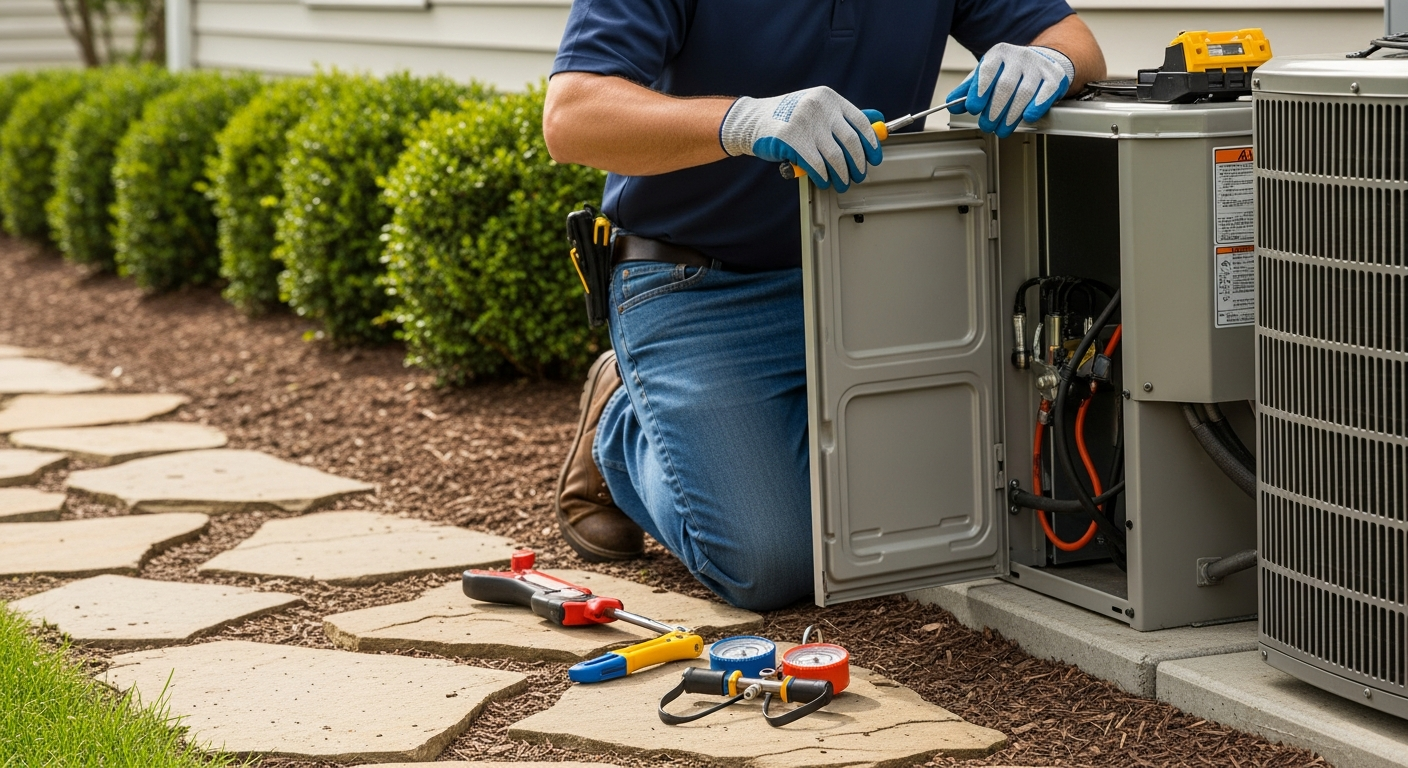
- Opening the electrical panel or adjusting wiring inside the condenser, air handler, or thermostat — capacitors hold a lethal charge even when power is off.
- Checking or adding refrigerant — requires EPA Section 608 certification and specialized gauges.
- Repairing or replacing any component that involves line voltage (contactor, capacitor, fan motor, compressor, circuit board).
- Using manifold gauges or refrigerant tanks.
- Bypassing safety switches or float switches.
- Attempting to repair or replace a blower motor or condenser fan motor.
If you smell burning, see sparks, or suspect a gas leak, turn off the system at the breaker and call a contractor immediately — these are emergency situations.
Use HVACDatabase Calculators to Make Confident Decisions
These free tools turn guesswork into numbers. Access them before calling a contractor so you can ask sharper questions.
- Repair-or-Replace Calculator: Compare repair costs against system age and replacement cost to see the long‑term financial picture.
- HVAC Cost Estimator: Get an editorial range for local prices on repairs, maintenance, and full system replacements.
- System Age Decoder: Find your AC’s manufacture date from the serial number to know if it’s still under warranty or nearing retirement.
- Quote Checker: Upload a contractor estimate to see if the scope and price align with market data.
Local Context
HVAC advice changes by market. In hot cities such as Phoenix or Las Vegas, cooling failures become urgent faster and summer schedules fill quickly. In humid markets such as Houston, Tampa, or Miami, drainage, mold risk, and humidity control matter as much as temperature. In cold markets such as Chicago or Minneapolis, no-heat calls can become safety issues during severe weather. Coastal homes may see faster outdoor-unit corrosion, while older homes often need duct, electrical, venting, or access corrections before equipment performs as advertised.
Methodology
HVACDatabase estimates combine common contractor price patterns, service-category pricing ranges, equipment complexity, urgency, regional labor variation, and known HVAC safety boundaries. Actual prices vary by city, brand, system size, access, warranty status, permit requirements, and whether the visit discovers ductwork, electrical, refrigerant, gas, or drainage issues. Use these numbers to sanity-check quotes, not as a guaranteed price.
FAQ
Can I handle Tips for Avoiding Summer AC Breakdowns myself?
You can handle basic checks such as thermostat settings, filter replacement, blocked vents, visible debris, and obvious water or ice. Anything involving refrigerant, gas, combustion, high-voltage electrical components, compressors, or sealed system work should be left to a qualified technician.
When should I call an HVAC contractor?
Call a contractor if the problem repeats, the system trips a breaker more than once, cooling or heating is weak after basic checks, you see ice or water where it does not belong, or the repair requires opening equipment panels.
How do I know if a quote is fair?
Compare the written scope, not just the price. A fair quote should explain the diagnosis, parts, labor, warranty, exclusions, and whether follow-up work may be needed.
Should I repair or replace the system?
Repair usually makes sense for newer equipment with minor failures. Replacement becomes worth comparing when the system is older, the repair is major, comfort is poor, or the repair approaches 40-50% of replacement cost.
What is the safest next step?
Do the safe homeowner checks first, document symptoms, then use HVACDatabase tools or contractor comparison pages if the issue points to mechanical, electrical, refrigerant, gas, or combustion work.
Related articles
Connect this page to adjacent guides so readers keep moving deeper into the topic cluster.

Tips for Choosing a Smart Thermostat for a Heat Pump
Learn which smart thermostat features prevent expensive auxiliary heat mistakes, how to verify compatibility, and when to call a pro.

Understanding C Wire Adapters for Smart Thermostats
Missing the C wire for your smart thermostat? C wire adapters solve power issues without pulling new wiring. Compare types, costs, and installation options.

Best Smart Thermostats for Multi Zone Homes
Discover which smart thermostats deliver accurate zoning, remote sensors, and energy savings for homes with multiple HVAC zones. Our guide helps you pick the right model and avoid costly compatibility mistakes.