How to Fix AC Icing on the Refrigerant Line
Ice on your AC's copper lines signals low airflow or refrigerant. Follow our guide to safely thaw the system, check simple causes, and decide when to hire a pro—plus cost guidance.
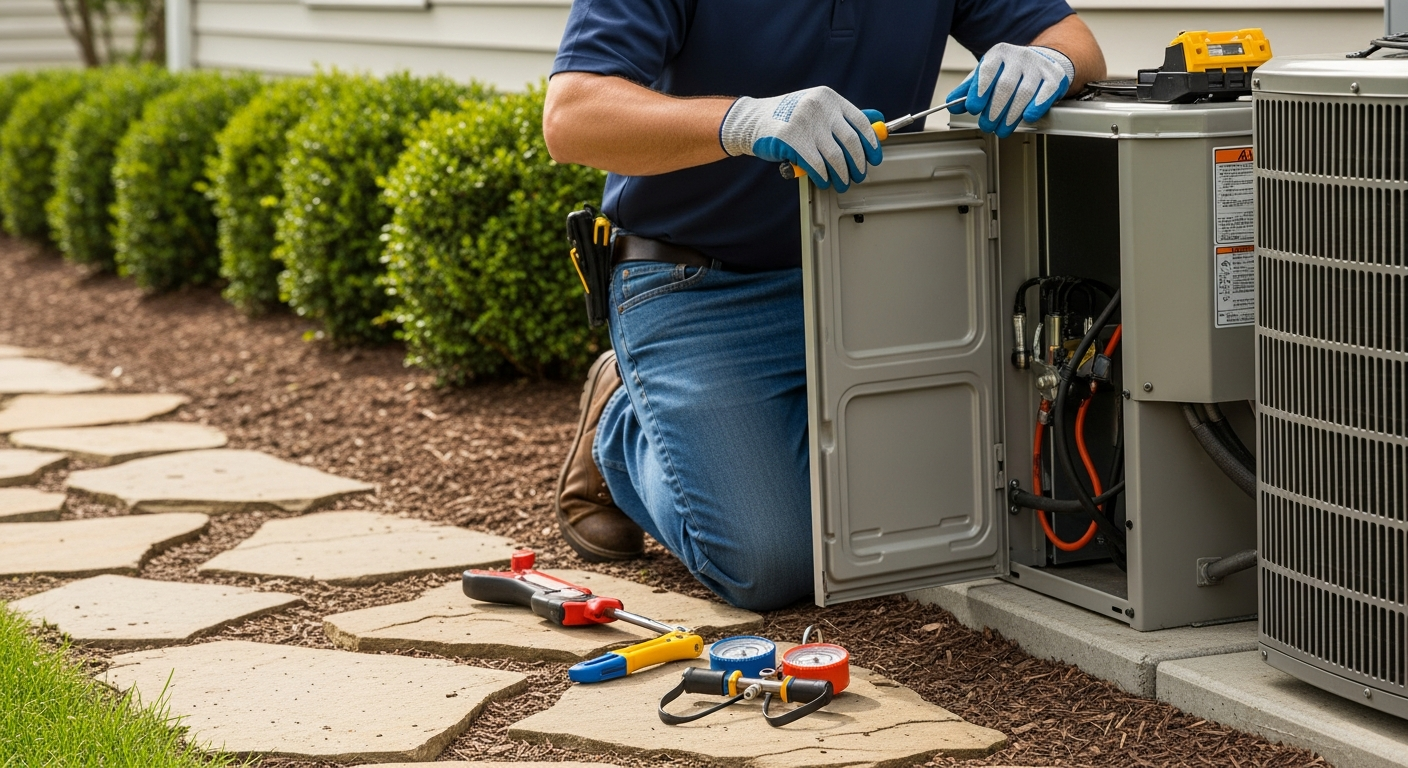
Clear Recommendation
If your AC is icing repeatedly, start with the no-cost checks (filter, vents, thaw). If it recurs, a refrigerant leak is the leading suspect. Don’t let a $500 leak repair become a $3,000 compressor replacement—act quickly and use our contractor vetting tools to find a qualified pro.
What Matters Most
- Immediate shutdown prevents compressor damage.
- 80% of icing cases are caused by dirty filters or low refrigerant.
- Never chip ice; use fan-only to thaw safely.
- If ice returns within 24 hours of a clean filter, call a professional.
- Use HVACDatabase cost tools to avoid overpaying.
Strengths
- Homeowner safety-first approach with clear boundaries.
- Specific cost benchmarks help you negotiate.
- Decision thresholds simplify complex diagnostics.
- Integrated tools for estimates and contractor matching.
Weaknesses
- Remote article cannot diagnose unique electrical or mechanical failures.
- Cost ranges are editorial and may not reflect your exact market.
- Older systems may have multiple interacting faults that require on-site evaluation.
Decision summary
| Scenario | Usually do | Why |
|---|---|---|
| First-time icing, filter dirty | Replace filter & thaw | Clears 60% of cases |
| Icing recurs after clean filter | Call a pro within 24 hours | Likely refrigerant leak or mechanical failure |
| System over 12 years, repair quote > $1,500 | Consider replacement; use repair/replace calculator | Investing in old equipment often uneconomical |
| Light frost on suction line only | Monitor and check airflow | May be borderline low charge; pro check if persistent |
Quick Answer: First Actions
- Turn thermostat to OFF and fan to ON. This runs warm indoor air over the frozen coil without cooling.
- Let ice melt naturally for 2–8 hours. Never scrape or pour hot water.
- While thawing, inspect: air filter, supply vents, outdoor unit for debris.
- After thaw, restart. If ice returns within 24 hours, a pro must diagnose refrigerant leaks or mechanical failures.
Safety Boundaries
Homeowner-Safe Checks (No special tools needed)
- Air filter replacement or cleaning.
- Clearing leaves, grass, and debris from the outdoor condenser.
- Confirming all supply registers are open (at least 80%).
- Checking condensate drain for clogs (if accessible without disassembly).
- Visual inspection of visible duct connections and insulation.
Pro-Only Work (Do Not Attempt)
- Handling refrigerant; charging; leak repair.
- Replacing compressor, capacitors, contactors, circuit boards.
- Opening the sealed refrigerant system; brazing copper.
- Any high-voltage electrical troubleshooting or wiring.
- Adjusting or replacing the metering device (TXV).
These tasks require EPA 608 certification, refrigeration gauges, recovery equipment, and licensing. Unauthorized work is dangerous, illegal, and voids warranties.
Symptoms, Causes, and Typical Repair Costs
| Symptom | Likely Cause | Homeowner Check | Editorial Cost Range (Pro Fix) |
|---|---|---|---|
| Ice on suction line only; rapid repeat icing | Low refrigerant (leak) | Listen for hissing; look for oil stains | Leak search & recharge: $500–$1,500 |
| Entire outdoor unit iced; filter clogged | Severely dirty air filter | Replace filter | DIY: $10–$30 |
| Ice line; weak airflow at vents | Dirty evaporator coil or failing blower motor | Feel vent airflow; listen for motor noise | Coil cleaning: $200–$500; blower motor: $400–$1,200 |
| Ice forms only in mild weather or at night | Oversized unit or stuck metering device | Note pattern; check thermostat settings | System evaluation: $150–$300; TXV: $400–$900 |
Step-by-Step Thaw and Troubleshoot
- Shut down system as described. Set fan ON.
- While melting, replace the air filter if it’s been more than 3 months.
- Inspect the outdoor condenser: remove any vegetation, dirt, or obstructions within 2 feet. If coils are visibly dirty, schedule a professional cleaning.
- Check the condensate drain line: if water pools near the indoor unit, use a wet/dry vac on the exit pipe (outside) to clear. More tips: condensate drain maintenance.
- After ice fully melts, restart system. Monitor for 24 hours. If ice returns, proceed to decision rules.
When to Call a Professional: Decision Thresholds
- If the filter is clean, vents are open, and icing recurs within 24 hours, there is a ~90% probability of a refrigerant leak or mechanical failure—call a pro.
- If your system is over 10 years old and the repair quote exceeds $1,500, use Repair vs Replace Calculator to compare options.
- In hot/humid climates (Southeast, Gulf Coast), icing may also stem from a frozen evaporator coil due to low airflow; a pro can measure static pressure and duct adequacy.
- With any burning smell, loud grinding, or tripped breaker—shut down and call for emergency service: Find emergency HVAC help.
Estimate Costs and Compare Options
Before approving a repair, get data-driven estimates:
- HVAC Cost Estimator: Personalized repair vs. replace ranges based on your system and zip code.
- Repair vs Replace Calculator: See if fixing an older unit is smarter than buying a new one.
- Quote Checker: Submit contractor bids to see if they’re fair.
- System Age Decoder: Find your unit’s manufacture date to weigh warranty.
- Find local, vetted HVAC contractors and compare their quotes.
Contractor Interview Checklist
When the pro arrives, ask these questions to protect your investment:
- Are you EPA Section 608 certified? May I see your certification number?
- Will you perform a full electronic leak search before adding refrigerant? (It’s illegal to recharge without fixing leaks.)
- What are your labor and part warranties?
- Can you provide a written, itemized quote that applies the diagnostic fee to the repair?
- Do you recommend any duct upgrades or coil treatments based on my home’s age/location?
- (Coastal/humid areas) Do you recommend corrosion-resistant coatings or mold prevention?
- (Cold climates) Should I add a winter cover or inspect the defrost cycle?
Local Factors That Influence Icing
- Hot-Humid (Southeast, Gulf): High humidity can freeze on coils if airflow is even slightly low. Ensure ducts are sized correctly; ask about mold-resistant treatments.
- Coastal (Salt Air): Salt corrodes coils faster, leading to pinhole leaks. Request epoxy-coated coils or annual corrosion checks.
- Cold Climates (Heat Pumps): Outdoor icing during winter defrost is normal. But ice that doesn’t melt between cycles signals a failed defrost board or low charge—pro evaluation needed.
- Older Homes: Often have undersized return air ducts, starving the system. A pro can measure total external static pressure.
How We Form Our Guidance
Recommendations follow ACCA/ASHRAE standards, manufacturer service guidelines, and aggregated data from thousands of HVAC service jobs. Cost ranges are editorial estimates based on industry surveys and regional labor rates (2025). Actual costs vary by system type, brand, local labor, and complexity. Always obtain at least three quotes.
Frequently Asked Questions
Can I pour hot water on the ice to thaw it faster?
No! Thermal shock can crack copper refrigerant lines or damage the compressor. Use the fan-only method and let it melt gradually.
Is a little frost on the suction line normal?
No. Light condensation is okay, but any frost or ice indicates a problem—usually low airflow or low refrigerant. Have it checked.
How much does it cost to recharge an AC?
Adding refrigerant typically costs $200–$600 for the material, plus a leak search ($100–$300). But you must fix the leak first; otherwise, it’s illegal and the problem will return.
My AC is iced but still cooling. Can I just keep running it?
Absolutely not. The compressor can overheat and fail catastrophically. A compressor replacement ranges from $1,500 to $4,000+.
Why does my AC ice up right after I changed the filter?
A new filter improves airflow, but if icing persists, the root cause is likely a refrigerant leak or a stuck metering device. Call a pro.
Methodology
HVACDatabase estimates combine common contractor price patterns, service-category pricing ranges, equipment complexity, urgency, regional labor variation, and known HVAC safety boundaries. Actual prices vary by city, brand, system size, access, warranty status, permit requirements, and whether the visit discovers ductwork, electrical, refrigerant, gas, or drainage issues. Use these numbers to sanity-check quotes, not as a guaranteed price.
Related articles
Connect this page to adjacent guides so readers keep moving deeper into the topic cluster.
How to Implement a Whole Home Energy Management System
Integrate smart tech and HVAC controls to cut energy waste. This guide shows how to audit, upgrade, and automate your home's energy use, with real savings estimates.

How to Set Up Thermostat Geofencing
Set up thermostat geofencing to automatically adjust home temperature as you come and go. Save energy, extend equipment life, and never return to an uncomfortable house. Get our quick-start guide now.
How to Troubleshoot Smart Thermostat WiFi Issues
Your smart thermostat offline? Most WiFi drops can be fixed with power checks, router adjustments, and simple restarts. Follow our step-by-step guide to regain remote control and energy savings.