10 Signs Your AC Needs Repair
Catch AC failures early. Learn the 10 signs, safe DIY checks, repair cost estimates, and use our calculators to decide between repair and replacement before a breakdown.
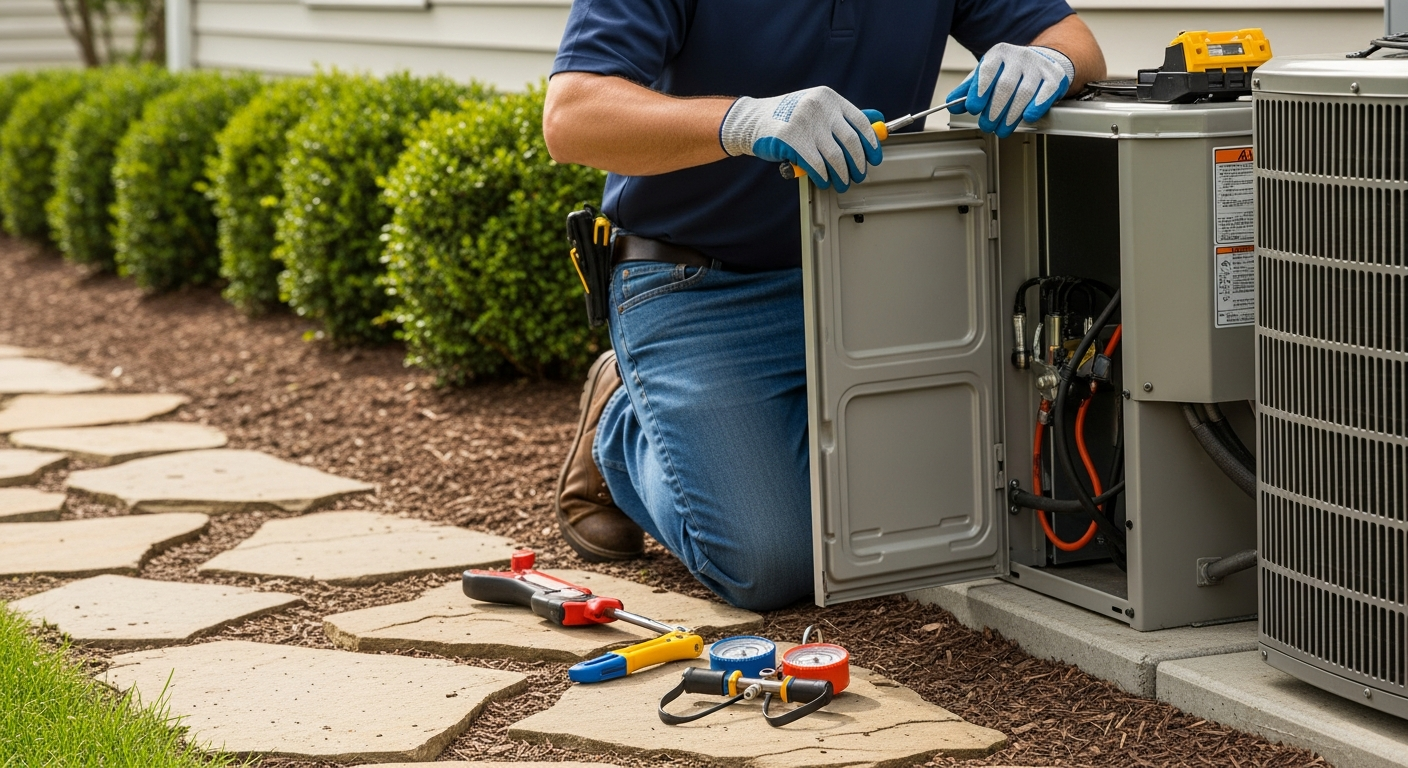
Act early on AC warning signs to avoid costly emergencies.
By checking simple items yourself and using our calculators, you can determine whether a repair or replacement is the smarter financial move before a breakdown forces your hand.
What Matters Most
- Ten common symptoms indicate potential AC failure, most of which homeowners can initially assess.
- Minor repairs under $1,000 are often worth it for systems under 8 years old.
- For older systems or expensive repairs, replacement may yield better long-term savings.
- Always get multiple contractor quotes and use our tools to verify fairness.
Strengths
- Empowers homeowners with concrete thresholds and DIY checks.
- Provides cost transparency to avoid overpaying.
- Integrates free tools for data-driven decisions.
Weaknesses
- Cost estimates are ranges, not quotes; actual costs vary.
- DIY checks cannot replace professional diagnostics.
- Regional incentives and prices may differ; use local rebate finder.
Decision Summary
| Scenario | Usually do | Why |
|---|---|---|
| AC <8 years, minor signs (noise, slight air loss) | Schedule a diagnostic & tune-up | Catch small issues early; repair costs low relative to replacement |
| AC 8-12 years, major repair needed (coils, leaks) | Seriously consider replacement | Avoid pouring money into an aging system; new units offer 30%+ efficiency gains |
| AC >12 years, any compressor or refrigerant issue | Replace unit | System near end of life; replacement often cheaper than repeated repairs |
| Spike in energy bills only (no other symptoms) | Professional energy audit first | Could be duct leaks, insulation, or meter issue; rule out before AC replacement |
Introduction
When summer heat peaks, a failing AC isn’t just uncomfortable—it’s a costly emergency waiting to happen. Most breakdowns don’t occur without warning. By recognizing these 10 telltale signs early, you can schedule a repair before a minor $200 fix becomes a $4,000 compressor replacement. In this guide, we’ll walk you through what to check safely on your own, when to call a licensed technician, and how to use our tools to compare repair versus replacement costs. Don’t wait for a full system failure; use this decision tool to protect your home and budget.
Quick Answer: 10 Signs & What to Do
If your AC shows any of the following, first check your thermostat settings and air filter. If problems persist, turn off the system and call a professional.
- Warm air from vents
- Weak airflow
- Frequent cycling (short-cycling)
- High indoor humidity
- Water leaks near indoor unit
- Foul or burning odors
- Loud or unusual noises
- Unexpected spike in energy bills
- Ice on refrigerant lines or coils
- System age over 10 years
Typical repair costs range from $150 for minor electrical fixes to over $1,500 for refrigerant leaks or motor work. Use our Repair or Replace Calculator to see if your situation warrants a new system.
10 Signs of AC Trouble: What to Check & When to Call a Pro
| Sign | Likely Causes | Safe DIY Checks | Estimated Repair Cost (Editorial Range) |
|---|---|---|---|
| 1. Warm air blowing | Thermostat mis-set, tripped breaker, refrigerant leak, compressor failure | Check thermostat is on “cool” and set below room temp; check circuit breaker; replace filter | $150 – $4,000+ |
| 2. Weak airflow | Clogged filter, blocked ducts, failing blower motor, frozen coil | Replace filter; ensure vents are open and unblocked | $100 – $1,500 |
| 3. Short-cycling | Oversized unit, dirty condenser coils, refrigerant leak, electrical fault | Clean condenser coils (see guide); check thermostat location away from heat sources | $200 – $1,800 |
| 4. High humidity indoors | Oversized unit, dirty evaporator coil, low refrigerant, duct leaks | Run exhaust fans; verify drain pan isn’t full; set fan to “auto” | $200 – $2,500 |
| 5. Water leaks | Clogged condensate drain, cracked drain pan, frozen coil | Clear visible drain line with wet/dry vac; check for clogged filter | $150 – $600 |
| 6. Foul odors | Mold/mildew on coil or ducts, burned wire insulation, dead pest | Inspect filter; sniff vents to isolate source; turn off the system if burning smell | $100 – $1,200 |
| 7. Unusual noises | Loose parts, worn belt, failing motor bearings, debris | Listen for sound type; tighten visible panels (power off) | $150 – $1,200 |
| 8. Energy bill spike | Dirty coils, refrigerant leak, failing components, duct leaks | Compare monthly bills; clean filter and condenser coils; schedule an energy audit | $200 – $3,000+ |
| 9. Frozen evaporator coil | Low airflow (dirty filter), low refrigerant, stuck contactor | Shut off system to thaw; replace filter; leave thawed coil access open | $500 – $2,500 |
| 10. Old system | Normal wear; outdated efficiency | Check manufacture date on nameplate (use our Age Decoder) | Replacement: $5,000 – $12,000+ |
Safety Boundaries: What You Can (and Cannot) Do Yourself
As a homeowner, you can perform several basic checks safely. However, opening sealed refrigerant lines, handling high-voltage components, or repairing gas furnaces poses serious risk. Always turn off power at the breaker before touching any equipment.
Safe to do:
- Replace the air filter monthly during heavy use (see filter replacement guide).
- Clean condenser coils with water hose (after power off) – step-by-step.
- Clear clogged condensate drain line with a wet/dry vac or brush.
- Check thermostat batteries and settings.
- Inspect ductwork for visible disconnects or leaks (seal with mastic if accessible).
- Tighten loose panels or cabinet screws.
Only a licensed HVAC technician should:
- Handle refrigerant – it requires EPA certification and specialized tools.
- Diagnose or replace capacitors, contactors, or control boards (shock risk).
- Open the compressor or sealed system.
- Repair gas lines or combustion components.
- Bypass any safety switches.
If you suspect a refrigerant leak or electrical fault, shut off the system and call a pro. Use our contractor finder for verified local experts.
Use Our Free Tools to Make the Right Decision
Before calling a contractor, gather data with these quick calculators:
- Repair or Replace Calculator: Enter repair cost, system age, and efficiency to see if replacement is smarter.
- System Age Decoder: Decode your unit’s serial number to find true age.
- HVAC Cost Estimator: Get a rough budget for common repairs or new installs based on your zip code.
- BTU & Sizing Calculator: Check if your current unit is sized correctly (short-cycling clue).
- Rebate Finder: See local utility incentives for efficient replacements.
Compare quotes from at least three licensed contractors using our Quote Checker.
Decision Rules: Repair, Tune-up, or Replace?
Apply these thresholds based on industry benchmarks (ASHRAE, Energy Star guidance):
- If your AC is less than 8 years old and the repair cost is under $1,000 → repair is usually cost-effective.
- If your AC is 8–12 years old and the repair exceeds 40% of a new system cost (e.g., $1,500 repair vs. $3,800 new unit) → seriously consider replacement. Use our calculator.
- If your AC is over 12 years old and needs compressor or evaporator coil repair → replacement is strongly recommended. Efficiency gains alone can pay back the difference.
- Energy bill spike >30% with no change in usage → indicates significant efficiency loss; get a professional energy audit. If coupled with other symptoms, replacement often brings best ROI.
- Multiple signs active at once (e.g., weak airflow + ice + noise) → implies systemic failure; prepare for major repair or full replacement.
Additionally, if your system uses R-22 refrigerant (phased out in 2020), repair costs are climbing due to scarce refrigerant. Use our cost estimator to factor that in.
Contractor Questions to Ask Before Approving Work
- “Is the diagnostic visit fee waived if I proceed with repair?” (Many apply it to the final bill.)
- “What are the warranties on parts and labor?” (Look for at least 1 year labor, and manufacturer parts warranty.)
- “Are you licensed, insured, and bonded in my state?” (Request proof.)
- “Can you provide a written, itemized estimate?”
- “Will you perform a Manual J load calculation before sizing replacement equipment?”
- “Do you pull required permits and handle inspections?”
- “What financing options or rebates do you offer?”
- “Can you provide local references from recent similar jobs?”
Always get at least three competitive quotes. Use our Contractor Comparison Tool to evaluate bids side-by-side.
Climate-Specific AC Concerns
Your location influences which symptoms are most critical:
- Hot, humid climates (Southeast US, Gulf Coast): High indoor humidity and mold growth are red flags. Ensure your AC is properly sized (not oversized) to avoid short-cycling that fails to dehumidify. Check for duct leaks that draw in muggy air.
- Dry, desert climates (Southwest): Dust clogs filters and coils rapidly. Frequent filter changes and coil cleaning are non-negotiable. Evaporative cooling add-ons may mask high humidity sensing—rely on standalone hygrometer.
- Cold climates (with AC or heat pumps): Frozen coils during cooling season signal low refrigerant or airflow. If your heat pump also struggles in winter, consider a dual-fuel system.
- Coastal areas: Salt air corrodes condenser coils and fins quickly. Inspect outdoor unit annually for corrosion; consider a corrosion-resistant model with aluminum fins.
- Older homes: Inadequate duct sizing or return air can cause airflow issues. A whole-home energy audit is wise before blaming the AC unit alone.
Methodology: How We Estimate AC Repair Costs
Our cost ranges are editorial estimates compiled from industry data (HomeAdvisor, Fixr, Angi, contractor surveys) and adjusted for typical homeowner scenarios. They represent average ranges across U.S. markets and exclude extreme outliers. Actual pricing will vary by system size, brand, accessibility, part availability, region, seasonality, and contractor overhead. These are not guaranteed quotes. Always obtain itemized bids from licensed professionals and use our Quote Checker to review fairness.
Decision tree thresholds are based on widely accepted HVAC lifecycle analysis (Department of Energy, ASHRAE) and our repair-or-replace calculator’s algorithm, which factors in the 5,000 rule (multiply repair cost by age; if >5,000, consider replacement).
Frequently Asked Questions
1. My AC is blowing warm air but the outside unit is running. What should I do first?
Check your thermostat settings (cool mode, temperature below room). Then ensure the circuit breaker hasn’t tripped. Replace the air filter—a clogged filter can cause the indoor coil to freeze and block cooling. If these steps don’t help, shut off the system and call a pro; you may have a refrigerant leak or compressor problem.
2. How much does an AC diagnostic visit typically cost?
A standard diagnostic visit ranges from $80 to $200. After-hours or emergency calls can be higher. Many contractors credit this fee toward the repair if you proceed. Ask upfront.
3. Can I clean my AC’s indoor evaporator coil myself?
We do not recommend it. The coil is often inside the air handler, difficult to access, and surrounded by sensitive components. A dirty coil can be cleaned by a technician during a maintenance visit. However, you can safely replace the filter and keep the drain line clear to prevent coil issues. For outdoor condenser coils, you can gently rinse them with a hose (power off) as shown in our condenser coil cleaning guide.
4. Why does my air conditioner smell musty when it turns on?
A musty odor usually means mold or mildew is growing on the evaporator coil or in the drain pan. Run the fan-only mode for an hour to dry out the system, then check the filter and drain. If the smell persists, a professional cleaning with antimicrobial treatment may be needed. Duct cleaning might also be considered.
5. Is it worth repairing a 15-year-old air conditioner?
Generally, no. At 15 years, your system’s SEER is likely much lower than modern units, and major repairs (compressor, coil) can approach 50% of replacement cost. Use our Repair or Replace Calculator to run the numbers. Efficiency savings often pay back the investment within a few years, and you’ll avoid future breakdowns.
Related articles
Connect this page to adjacent guides so readers keep moving deeper into the topic cluster.

Tips for Choosing a Smart Thermostat for a Heat Pump
Learn which smart thermostat features prevent expensive auxiliary heat mistakes, how to verify compatibility, and when to call a pro.

Understanding C Wire Adapters for Smart Thermostats
Missing the C wire for your smart thermostat? C wire adapters solve power issues without pulling new wiring. Compare types, costs, and installation options.

Best Smart Thermostats for Multi Zone Homes
Discover which smart thermostats deliver accurate zoning, remote sensors, and energy savings for homes with multiple HVAC zones. Our guide helps you pick the right model and avoid costly compatibility mistakes.