Commercial HVAC Installation Cost Guide
From rooftop units to VRF systems, get clear cost ranges and decision rules for your commercial property. Compare quotes with confidence.
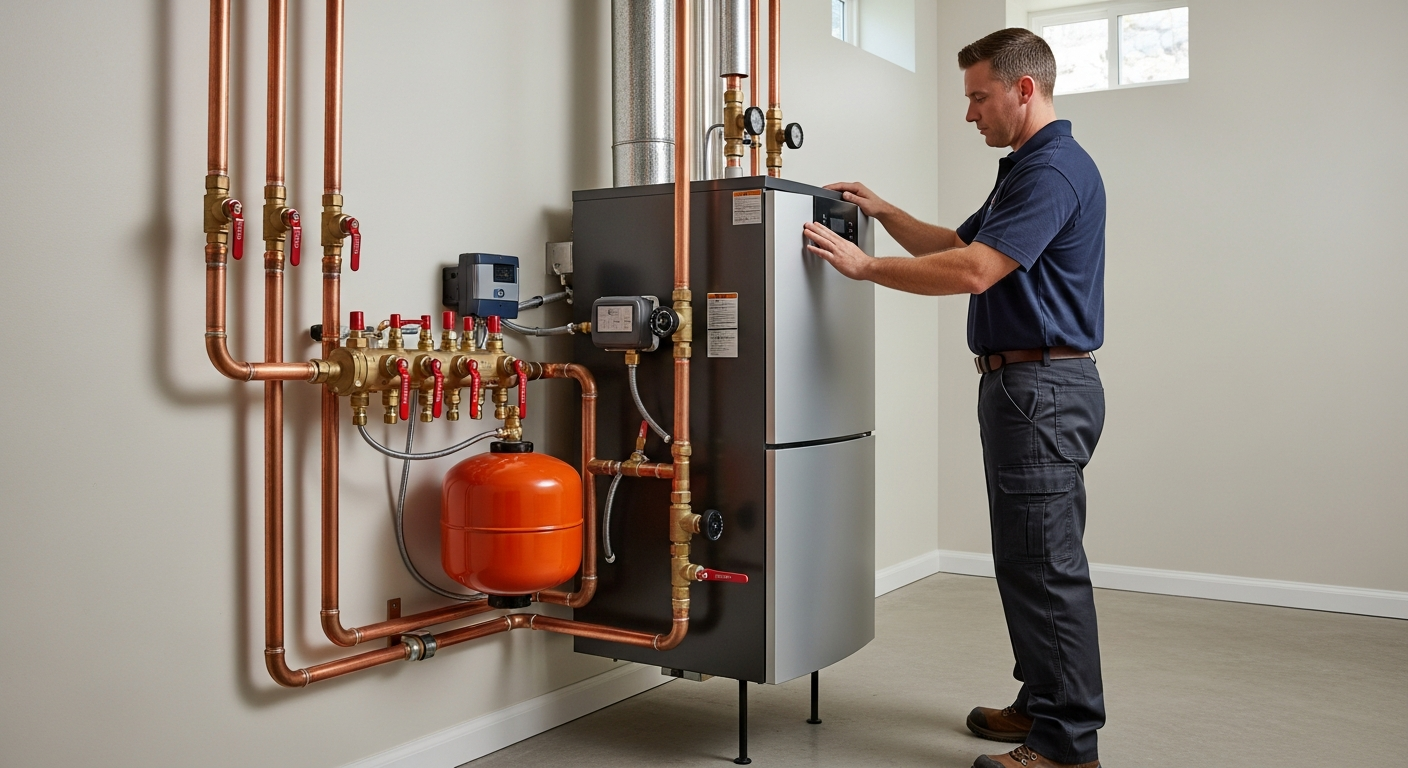
Get multiple quotes and verify contractor credentials before committing to a commercial HVAC installation.
For most commercial properties, a properly sized rooftop unit or VRF system installed by a qualified contractor offers the best balance of upfront cost and long-term efficiency. Avoid choosing the lowest bid without reviewing load calculations and references.
What Matters Most
- Commercial HVAC installation costs range from $4,000 to $30,000+ depending on system type, size, and ductwork needs.
- Labor accounts for 30-50% of total project cost; complex installations or off-hours work increase expenses.
- Always request a Manual N load calculation for commercial spaces to avoid oversizing or undersizing.
- Link to our cost estimator and BTU calculator to refine your budget before soliciting quotes.
Strengths
- Rooftop units are cost-effective and easy to maintain for single-zone commercial spaces.
- VRF systems offer energy efficiency and individual zone control for multi-room buildings.
- Choosing a contractor with local experience ensures compliance with codes and climate-specific design.
Weaknesses
- Chiller and geothermal systems have high upfront costs, though payback over time may justify investment.
- Retrofitting existing ductwork can significantly add to costs if not planned.
- Lowest-bid installations may lead to frequent repairs and higher utility bills.
Decision summary
| Scenario | Usually do | Why |
|---|---|---|
| Small office (under 5,000 sq ft) | Single-zone packaged rooftop unit | Lowest upfront cost, easy maintenance, handles typical load |
| Multi-tenant retail or office with varying occupancy | VRF or multi-split system | Independent zone control saves energy and improves comfort |
| Large warehouse or manufacturing floor | High-volume, low-speed (HVLS) fans + rooftop unit | Air circulation reduces need for extreme temperature control |
| Old building with no existing ductwork | Ductless mini-splits or VRF | Avoids major duct retrofit expense, offers flexibility |
| Medical or lab environment | Chilled water or VRF with high filtration | Meets strict air quality and temperature stability requirements |
Introduction
Installing a commercial HVAC system is a major investment, with costs typically ranging from $4,000 to over $30,000 depending on system type, size, and building specifics. This guide is designed for property owners and managers who need practical, actionable information to budget accurately and select the right system. Whether you're outfitting a small office, a retail space, or a light industrial facility, you'll find cost breakdowns, decision rules, and a contractor checklist to help you avoid overpaying or undersizing. Use our embedded tools to refine your estimates before getting quotes.
Quick Answer: Commercial HVAC Installation Cost Ranges
Based on editorial estimates for typical light commercial projects (5,000–20,000 sq ft), expect to pay:
- Single-zone rooftop unit (RTU): $4,000–$12,000+ installed
- VRF/multi-split system: $10–$25 per square foot (higher for complex zoning)
- Chiller system: $15–$35+ per square foot for large buildings
- Ductless mini-split: $3,000–$8,000 per zone (small offices)
These are editorial estimates, not guaranteed prices. Actual costs vary by region, contractor, brand, and existing conditions.
Key Factors That Influence Your Budget
System Type and Capacity
The equipment you choose is the biggest cost driver. A basic rooftop unit (RTU) is cost-effective for open or single-zone spaces, while a variable refrigerant flow (VRF) system offers superior efficiency and zone control but at a higher upfront price. Capacity, measured in tons, directly affects both hardware and labor. Learn more about choosing the right system: How to Choose a Commercial HVAC System.
Ductwork and Infrastructure
If retrofitting an older building, the condition of existing ductwork matters. Replacing or modifying large-scale ventilation can add thousands. New construction allows for ductwork designed to match the system, but material costs are significant. For perfect sizing, use our BTU Calculator and consult a professional for a Manual N load calculation.
Building Usage and Environmental Requirements
A warehouse has different needs than a medical office. Specialized facilities may require advanced filtration, humidity control, or precise temperature ranges, which increase cost. How to Size a Commercial HVAC System can help you avoid costly mistakes.
Electrical and Control Systems
Commercial units often require three-phase power. Upgrading your electrical panel or adding controls (like smart thermostats or building management systems) adds to the total. For preventive maintenance strategies, see Preventive Maintenance for Commercial HVAC.
Average Installation Costs by System Type
Below are editorial estimates for common light commercial installations, including equipment and labor but excluding major ductwork or electrical upgrades.
| System Type | Typical Application | Estimated Installed Cost (USD) |
|---|---|---|
| Single-Zone Packaged Rooftop Unit (RTU) | Small retail, restaurants, offices up to 5,000 sq ft | $4,000 – $12,000 |
| Multi-Zone RTU or Split System | Medium offices, clinics with separate rooms | $8,000 – $25,000 |
| VRF System (Heat Pump or Heat Recovery) | Multi-tenant buildings, hotels, flexible spaces | $10 – $25 per sq ft |
| Ductless Mini-Split (per indoor unit) | Small offices, server rooms, additions | $3,000 – $8,000 per zone |
| Chiller System (air- or water-cooled) | Large commercial, industrial, or high-rise | $15 – $35+ per sq ft |
Labor typically accounts for 30% to 50% of the total project cost. Complex installations, such as those requiring crane lifts, off-hours work, or extensive piping, can push labor costs higher.
Decision Rules: When to Replace vs. Repair
Use these concrete thresholds when evaluating your existing commercial HVAC system:
- If the system is over 15 years old and needs a compressor replacement ($1,500–$4,000+), replacement is often more cost-effective.
- If the repair cost exceeds 50% of a new system’s price, choose replacement.
- If you’ve had two or more major breakdowns in the past year, reliability is compromised — plan for replacement.
- If you’re spending more than 20% of your monthly energy bill on HVAC compared to similar buildings, a high-efficiency replacement may pay for itself.
For a detailed analysis: Repair or Replace Calculator.
Safety Boundaries: What You Can Check and When to Call a Pro
Homeowner/Manager Safe Checks:
- Inspect air filters monthly; replace or clean as needed.
- Verify thermostat settings and battery condition.
- Ensure no furniture or boxes block supply and return vents.
- Listen for unusual noises and note any odors.
- Check for visible water leaks around indoor units.
- Keep outdoor units clear of debris, leaves, and ice.
Professional-Only Work (Do Not Attempt Yourself):
- Refrigerant line repair or charging (requires EPA certification).
- Gas valve, burner, or combustion chamber work (risk of fire/explosion).
- Electrical components like compressors, capacitors, contactors, or control boards (high-voltage risk).
- Ductwork modifications that affect system pressure and airflow design.
- Any troubleshooting that involves opening sealed panels beyond the filter door.
If you suspect a refrigerant leak or electrical fault, shut off power and call a licensed commercial HVAC contractor immediately. For emergency situations, use our Emergency HVAC Service Finder.
Tools to Plan Your Project
Get data-driven estimates before contacting contractors:
- HVAC Cost Estimator – Input your building specs for a rough budget range.
- BTU Calculator – Find the right heating/cooling capacity for your space.
- Repair or Replace Calculator – Weigh the economics of fixing vs. upgrading.
- Rebate Finder – Check for local utility incentives on high-efficiency commercial equipment.
Contractor Checklist: Questions to Ask Before You Approve the Job
- Are you licensed, bonded, and insured for commercial HVAC work in this state? Verify credentials.
- Will you provide a Manual N load calculation? Essential for sizing; avoid rule-of-thumb guesses.
- What is the warranty on equipment and labor? Commercial warranties may differ from residential.
- Can you supply references from similar commercial projects? Check recent installations.
- Do you have experience with [your system type, e.g., VRF, RTU]? Specialization matters.
- What is the payment schedule and timeline? Avoid large upfront payments before work begins.
- Will you handle permits and coordinate inspections? A pro should manage this.
- Do you offer a maintenance plan after installation? Regular tune-ups extend system life.
Use our Contractor Comparison Tool to evaluate multiple bids side by side.
Regional Considerations
Hot, Humid Climates (e.g., Southeast U.S.): Prioritize dehumidification features and corrosion-resistant coils. Oversizing cooling can lead to short cycling and poor humidity control.
Cold Climates (e.g., Midwest, Northeast): Heating capacity and efficiency are critical. Consider dual-fuel systems or heat pumps rated for low temperatures. For example, in Chicago, IL, heating loads dominate design.
Dry, Hot Climates (e.g., Southwest): High cooling loads require efficient condensers; evaporative cooling may be an option for some spaces. In Phoenix, AZ, peak summer temperatures demand reliable AC.
Coastal Areas: Salt air accelerates corrosion; specify marine-grade units or protective coatings.
Older Buildings (Pre-1980s): Electrical upgrades (single-phase to three-phase) and asbestos mitigation may be necessary; budget for additional testing and remediation.
Methodology
Our editorial cost estimates are derived from a combination of national contractor surveys, manufacturer MSRPs, Bureau of Labor Statistics data on HVAC labor rates, and our own database of submitted project quotes. Ranges reflect typical light commercial installations in the U.S. and assume standard conditions with no major structural retrofits. These are not guaranteed prices; always solicit at least three itemized bids from qualified local contractors. We update estimates quarterly to reflect material and labor market changes.
Frequently Asked Questions
How much does a commercial HVAC system cost per square foot?
For light commercial spaces, expect $10–$35 per square foot installed, depending on system type and complexity. Basic rooftop units fall at the lower end; VRF or chiller systems at the higher end.
What size HVAC do I need for my commercial space?
Sizing is not a simple square-footage rule. A professional Manual N calculation accounts for insulation, windows, occupancy, equipment, and local climate. As a rough guideline, small offices might need 1 ton per 400–600 sq ft, but use our BTU Calculator for a starting point.
How long does a commercial HVAC installation take?
A simple rooftop replacement on a small building can take 1–2 days. Full new installations with ductwork and zoning may take 1–4 weeks, depending on complexity and access.
Can I finance a commercial HVAC system?
Yes, many contractors offer financing or partnerships with lenders. Additionally, look for local utility rebates and federal tax incentives for energy-efficient equipment. Use our Rebate Finder to see what’s available.
What are the signs I need to replace my commercial HVAC?
Frequent breakdowns, uneven temperatures, rising energy bills, and a system age over 15 years are strong indicators. Use the Repair or Replace Calculator for an economic comparison.
Related articles
Connect this page to adjacent guides so readers keep moving deeper into the topic cluster.

Cost to Install Multiple Smart Thermostats
Get a clear cost breakdown for installing 2–4+ smart thermostats. Includes equipment, labor, zoning upgrades, and how to save with utility rebates. Practical checks and contractor questions inside.
Duct Booster Fan Installation Cost
Uneven room temps? Duct booster fan installation costs: register fans $30–$100 DIY, inline fans $500–$800+ with pro. Learn when a booster works and when you need a bigger fix.
Makeup Air Unit Installation Cost Guide
Expect to pay $1,500–$4,500 for a pro-installed makeup air unit. Discover passive vs. tempered options, code triggers, and money-saving decision rules.