How to Monitor Commercial HVAC Performance
Learn how to track commercial HVAC efficiency with KPIs, sensors, and maintenance. Cut energy bills and avoid surprises with our step-by-step monitoring plan.

Clear Recommendation
Monitoring commercial HVAC performance is a high-return investment. Even basic bill tracking and filter maintenance can prevent 30% of emergency repairs. For larger facilities, integrate a BAS with setpoint alerts and track KPIs monthly.
What Matters Most
- Start monitoring your energy bills month-over-month for early warning of efficiency drift.
- Install a smart thermostat with runtime tracking if you don’t have BAS.
- Create a simple log of temperature splits and unusual noises.
- Use HVACDatabase tools to estimate costs and compare contractor quotes before committing.
- Act on thresholds immediately: >15% energy spike? Schedule a diagnostic.
Strengths
- Prevents costly emergency repairs by catching issues early.
- Reduces energy waste, typically saving 5–20% on HVAC bills.
- Extends equipment life by ensuring it runs within design parameters.
- Provides data to justify capital replacement to stakeholders.
Weaknesses
- Initial BAS investment can be high for small buildings; low-cost methods should be tried first.
- Requires consistent attention; monitoring only works if someone acts on the data.
- Some KPIs (like static pressure) need professional sensors or gauges.
- Over-reliance on automation may lead to skipping physical inspections.
Decision summary: Which monitoring approach fits your building?
| Scenario | Usually do | Why |
|---|---|---|
| Small office/retail under 2,500 sq ft, single zone | Use a smart thermostat + monthly bill tracking + annual contractor tune-up ($150–$300 plan) | Cost-effective, catches major issues; no full BAS needed |
| Mid-size building (2,500–20,000 sq ft) with multiple zones | Install a cloud-connected BAS (Energy Star certified) and tie to service contracts with KPI reporting | Balances cost with visibility; ROI often within 2–3 years from energy savings |
| Large facility or campus with central plant | Deploy full BAS and dedicated facility staff or 24/7 monitoring service | Critical to avoid downtime; remote alarms reduce risk |
| Older system (>12 years) with frequent repairs | Prioritize system replacement evaluation using repair-or-replace calculator before investing in monitoring | Monitoring can’t fix end-of-life inefficiency; new unit may yield better returns |
Quick Answer
To monitor commercial HVAC performance, track five signals: air temperature splits, cycle times, monthly kWh usage, air filter condition, and unusual noise. No special equipment is needed for basic checks. For larger buildings, add a Building Automation System (BAS) with automated alerts and smart sensors. Use our repair or replace calculator and the contractor checklist below to decide when to call a pro.
Key Performance Indicators That Reveal HVAC Health
Tracking the right data turns guesswork into clear action. Below are the KPIs every property manager or owner should watch, with safe ranges and steps to take when numbers drift.
| KPI | What It Means | Target Range | Action if Out of Range |
|---|---|---|---|
| Supply/Return Air Temp Split | Heat exchange efficiency | AC: 15–22°F; heat pump: 20–30°F | Clean coils, check refrigerant (pro only) |
| Cycle Time | System runtime per hour | Varies with load; avoid short-cycling (<10 min on) | Evaluate load with BTU calculator; check sensor |
| Energy Use (kWh) | Month‑over‑month baseline | Spike >10‑15% without weather change | Inspect filters, belts, motors; use cost estimator |
| Static Pressure | Airflow resistance | 0.5–1.0 inch water column | High: dirty filter or duct restriction; Low: fan issue |
| CO2 Levels | Ventilation effectiveness | <1000 ppm | Increase fresh air, check economizer |
For deeper insight, decode your unit’s capacity and efficiency rating with our system age decoder.
Safety Boundaries: What You Can (and Cannot) Do Yourself
Safe homeowner checks: Visual inspection of cabinets, ducts, and drains; replacing air filters (guide); listening for grinding or screeching; monitoring thermostat schedules and setpoints; tracking monthly bills for abnormal spikes; clearing debris from outdoor units.
Pro‑only work: Any task involving refrigerant, natural gas, high‑voltage electrical, compressors, capacitors, contactors, or control‑board replacement. Installing hard‑wired sensors or tapping into ductwork for pressure readings also requires a licensed technician. When in doubt, search our contractor directory or compare local pros on our comparison page.
Use HVACDatabase Tools to Quantify Decisions
Before you call a contractor, run the numbers yourself. Our free tools translate raw data into dollar decisions:
- HVAC cost estimator – ballpark repair or replacement cost for your ZIP code
- Repair or replace calculator – compares repair cost vs. new‑unit payoff
- System age decoder – find the age and efficiency from the model number
- BTU calculator – right‑size equipment and avoid oversizing
- Rebate finder – local utility incentives that can cover 10‑50% of upgrade costs
- Contractor comparison – get multiple quotes with the same scope of work
Decision Rules: When to Act (and How Fast)
Use these concrete thresholds to prioritize your next move. All estimated costs are editorial ranges, not guaranteed prices.
| Observation | Threshold | Urgency | Next Step |
|---|---|---|---|
| Energy bill spike vs. same month last year | >15% increase | High (within 1 week) | Check filters, then schedule diagnostic ($80–$200) |
| System short‑cycling (on/off frequently) | Runs <10 min | Medium (within 1 month) | Use BTU calculator; ask contractor to evaluate load |
| Uneven heating/cooling between zones | Temp difference >5°F | Medium | Balance dampers, check VAV boxes, consider zoning |
| Unusual noise (grinding, screeching) | Persistent after restart | Immediate (shut down) | Call pro; could be bearing, belt, or compressor |
| System age >12 years, major repair needed | Repair quote >50% of replacement | Low but plan ahead | Use repair/replace calculator; get replacement quotes |
Building Automation and Sensors: What to Know Before You Buy
A BAS centralizes data from sensors and controls, giving real‑time dashboards and instant alerts. For a small office (under 2,500 sq ft), a premium smart thermostat with energy tracking ($200–$500) may suffice. Larger buildings typically require a full BAS: editorial install range $5,000–$15,000 for a 5,000‑sq‑ft retrofit. Smart sensors add wireless monitoring of vibration, humidity, temperature, and CO2 – critical for high‑occupancy spaces like gyms (choosing the right system). Always ask for BACnet or Modbus protocol compatibility to future‑proof your setup.
Contractor Checklist for Monitoring Upgrades
Before hiring a contractor to install monitoring or assess performance, ask these questions:
- “Do you offer a performance monitoring contract? What KPIs will you track and report?”
- “Can you integrate my existing equipment with a BAS? What protocols do you use?”
- “What sensors do you recommend for my building type and climate?”
- “Will you provide a detailed analysis of my utility bills and system runtime?”
- “What is your service response time when an alert triggers?”
- “Are you familiar with local rebates for energy‑efficient upgrades? Can you help me file?”
- “Provide at least three references for commercial HVAC monitoring projects similar to mine.”
For a full maintenance framework, see our guide on setting up a preventive maintenance plan.
Local Climate Considerations
Monitoring priorities shift with geography:
- Hot/Humid (Gulf Coast, Southeast): Watch humidity and coil cleanliness; condensate drains must flow freely. Learn how to spot a leaking drain pan, but leave repairs to a pro.
- Cold (Midwest, Northeast): Focus on defrost cycles for heat pumps and backup heat operation. Verify economizer logic during mild weather.
- Coastal (salt air): Inspect outdoor coils for corrosion monthly; schedule more frequent cleanings.
- Older buildings: Retrofitting wireless sensors can add monitoring without disrupting walls. Check our cost estimator for zone‑by‑zone upgrade pricing.
How We Formulate Monitoring Recommendations and Cost Estimates
Our advice combines ASHRAE guidelines, manufacturer service manuals, national contractor surveys, and project data from commercial facilities. Cost ranges are editorial estimates based on typical mid‑market pricing in 2025 and will vary by region, system size, and access. Always confirm with at least three local quotes through our contractor comparison tool. Repair vs. replace thresholds follow the widely used “50% rule,” but actual ROI depends on your energy rates and rebates – use our calculator for a personalized result.
Frequently Asked Questions
How often should I monitor commercial HVAC performance?
At minimum, review energy bills monthly, check BAS alerts daily (if available), and walk the building quarterly. Increase frequency during extreme weather or high‑occupancy periods.
What is the best low‑cost monitoring for a small commercial space?
Start with a Wi‑Fi smart thermostat ($100–$300) that tracks runtime and compares usage to weather. Pair it with manual filter checks and a seasonal contractor tune‑up ($150–$300/year). Use our BTU calculator to confirm the unit isn’t oversized.
Can smart thermostats replace a full Building Automation System?
For a single zone under 5 tons, yes. But for multiple zones, varying occupancy, or ventilation‑dependent spaces, a BAS is necessary because it monitors static pressure, CO2, and multiple sensor points simultaneously. A smart thermostat alone cannot meet ASHRAE 62.1 ventilation requirements in larger buildings.
How much does it cost to install a Building Automation System?
Editorial estimate: $2,000–$8,000 for a small‑office retrofit; $10,000–$50,000+ for a 20,000‑sq‑ft building. Annual monitoring service fees add $500–$2,000. Use our cost estimator to narrow the range for your property.
What are signs my commercial HVAC is oversized?
Short‑cycling (on for less than 10 minutes), high humidity even during cooling, and temperature swings of more than 5°F between rooms. Oversizing cuts efficiency and accelerates wear. Run a load calculation with our BTU calculator and compare to the equipment’s rated capacity (found via system age decoder).
For further reading, explore rooftop unit maintenance or how to choose a commercial HVAC contractor.
Methodology
HVACDatabase estimates combine common contractor price patterns, service-category pricing ranges, equipment complexity, urgency, regional labor variation, and known HVAC safety boundaries. Actual prices vary by city, brand, system size, access, warranty status, permit requirements, and whether the visit discovers ductwork, electrical, refrigerant, gas, or drainage issues. Use these numbers to sanity-check quotes, not as a guaranteed price.
Related articles
Connect this page to adjacent guides so readers keep moving deeper into the topic cluster.
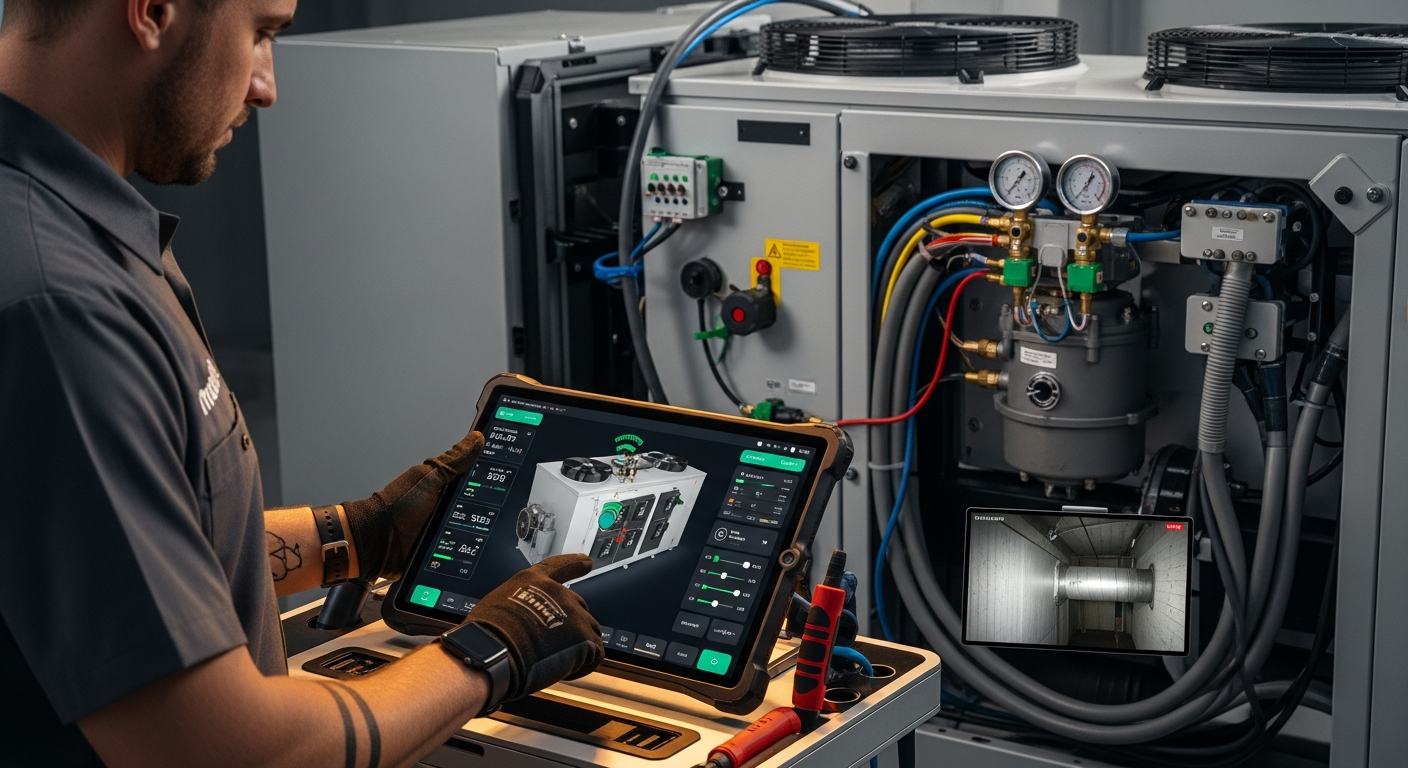
How to Implement a Whole Home Energy Management System
Integrate smart tech and HVAC controls to cut energy waste. This guide shows how to audit, upgrade, and automate your home's energy use, with real savings estimates.

How to Set Up Thermostat Geofencing
Set up thermostat geofencing to automatically adjust home temperature as you come and go. Save energy, extend equipment life, and never return to an uncomfortable house. Get our quick-start guide now.
How to Troubleshoot Smart Thermostat WiFi Issues
Your smart thermostat offline? Most WiFi drops can be fixed with power checks, router adjustments, and simple restarts. Follow our step-by-step guide to regain remote control and energy savings.