Signs Your Home Has Poor Indoor Air Quality
Is your home making you sick? Recognize signs like excessive dust, musty odors, and condensation. Get practical fixes and know when to call a pro.
Be Proactive About Your Indoor Air
Don't wait for visible mold or chronic symptoms. Use objective thresholds and professional tools to maintain healthy air before problems escalate.
What Matters Most
- Monitor humidity and CO2 levels with inexpensive devices.
- Upgrade to MERV 13 filters and check them monthly.
- Use exhaust fans and consider mechanical ventilation for consistent fresh air.
- Get professional help for mold beyond small patches and for duct sealing/cleaning.
- Leverage free online tools to estimate costs and vet contractors.
Strengths
- Addresses root causes, not just symptoms.
- Combines DIY monitoring with pro interventions at clear thresholds.
- Cost-effective first steps can resolve many common IAQ issues.
Weaknesses
- Some solutions require significant upfront investment (ERVs, dehumidifiers).
- Older homes may have multiple interrelated issues making diagnosis complex.
- Air quality monitors have limitations; professional testing may still be needed.
What's the Best Approach for You?
| Scenario | Usually do | Why |
|---|---|---|
| Mild symptoms, no visible mold | Start with monitoring and filter upgrade | Low-cost, non-invasive first step. |
| Condensation, musty smell | Install dehumidifier and improve exhaust | Controls moisture source; prevents mold. |
| Persistent dust, allergies | Seal ducts, upgrade filtration, add air purifier | Targets airborne particles effectively. |
| Stale air, high CO2 readings | Add mechanical ventilation (ERV/HRV) | Ensures fresh air exchange without energy waste. |
Quick Answer: Red Flags You Can't Ignore
Poor indoor air quality often announces itself through a combination of symptoms, visible clues, and comfort issues. If you notice any of the following, your home's air needs attention:
- Health signals: Unexplained headaches, congestion, coughing, or fatigue that ease when you leave home.
- Visual clues: Dust returns within 48 hours after cleaning; mold or mildew spots on walls, vents, or windowsills.
- Airflow and humidity: Persistent musty smells; condensation on windows; air feels heavy or stale.
Immediate step: Check your HVAC filter—if it's clogged, replace it. Then use our Air Quality Score tool to gauge your risk level.
Symptom-to-Action Table
Use this table to connect what you observe with likely causes and next steps.
| Sign | What It Usually Means | DIY Check / First Step | Call a Pro When |
|---|---|---|---|
| Excessive dust buildup | Leaky ducts, poor filtration, or dirty evaporator coil | Inspect filter; visually check accessible ducts for gaps | Dust returns in <48 hrs despite new filter; need duct sealing or coil cleaning |
| Musty odor | High humidity, mold in ducts or walls | Measure humidity (target 30–50%); sniff near vents | Odor persists after dehumidification; visible mold growth on surfaces |
| Condensation on windows | Excess indoor humidity or poor ventilation | Use a hygrometer; run exhaust fans more often | Condensation is constant; signs of wood rot or mold on frames |
| Allergy-like symptoms at home | Airborne allergens (dust mites, pet dander, pollen, mold spores) | Upgrade to MERV 13 filter; use portable air purifier | Symptoms severe; need whole-home air purification or duct cleaning |
| Stale air / rooms feel stuffy | Insufficient fresh air exchange | Open windows when weather permits; check if exhaust fans are working | Chronic stuffiness; consider ERV/HRV installation |
Understanding Your Home's Air Quality Warning Signs
Indoor air can be 2–5 times more polluted than outdoor air, per EPA. Because modern homes are built tight to save energy, pollutants get trapped. Recognizing patterns helps you avoid guesswork and unnecessary spending.
Health Symptoms That Point to Your Home
Symptoms like sneezing, itchy eyes, dry throat, or brain fog often align with time spent indoors. If they disappear at the office or on vacation, the air in your living space is suspect. Common triggers include volatile organic compounds (VOCs) from paints, cleaners, and furniture, as well as biological contaminants like mold and dust mites. Upgrading filtration is a proven remedy—learn about filter choices here.
Visible Clues You Shouldn't Sweep Away
Dust: A light film on surfaces days after cleaning suggests your HVAC system isn't filtering effectively or ductwork is pulling in attic/crawl space debris. Check your filter's MERV rating—most homes benefit from MERV 8–13. Mold: Even small patches release spores that aggravate asthma. Mold grows where moisture lingers; a whole-home dehumidifier or better bathroom exhaust can stop it. See bathroom exhaust installation guidance.
Air That Smells or Feels Wrong
Musty, stale, or chemical-like odors indicate trapped pollutants. High humidity (above 60%) not only feels muggy but encourages dust mites and mold. Condensation on windows is a clear signal: if outdoor temps are cold and indoor humidity is 40%+, you need dehumidification. Using exhaust fans while cooking and showering is a no-cost first step.
Safety Boundaries: What You Can Check vs. What You Should Leave to a Pro
Homeowners can safely perform these checks and improvements without risk:
- Replace disposable HVAC filters—use the arrow direction and ensure power is off to the unit (switch at thermostat or breaker).
- Inspect visible ductwork for gaps, dents, or disconnections in attic/basement.
- Use a hygrometer (under $15) to monitor humidity levels.
- Deploy a consumer air quality monitor that measures PM2.5, CO2, and VOCs to identify trends.
- Clean accessible vents and grilles with a vacuum and damp cloth.
- Run exhaust fans and open windows when weather allows.
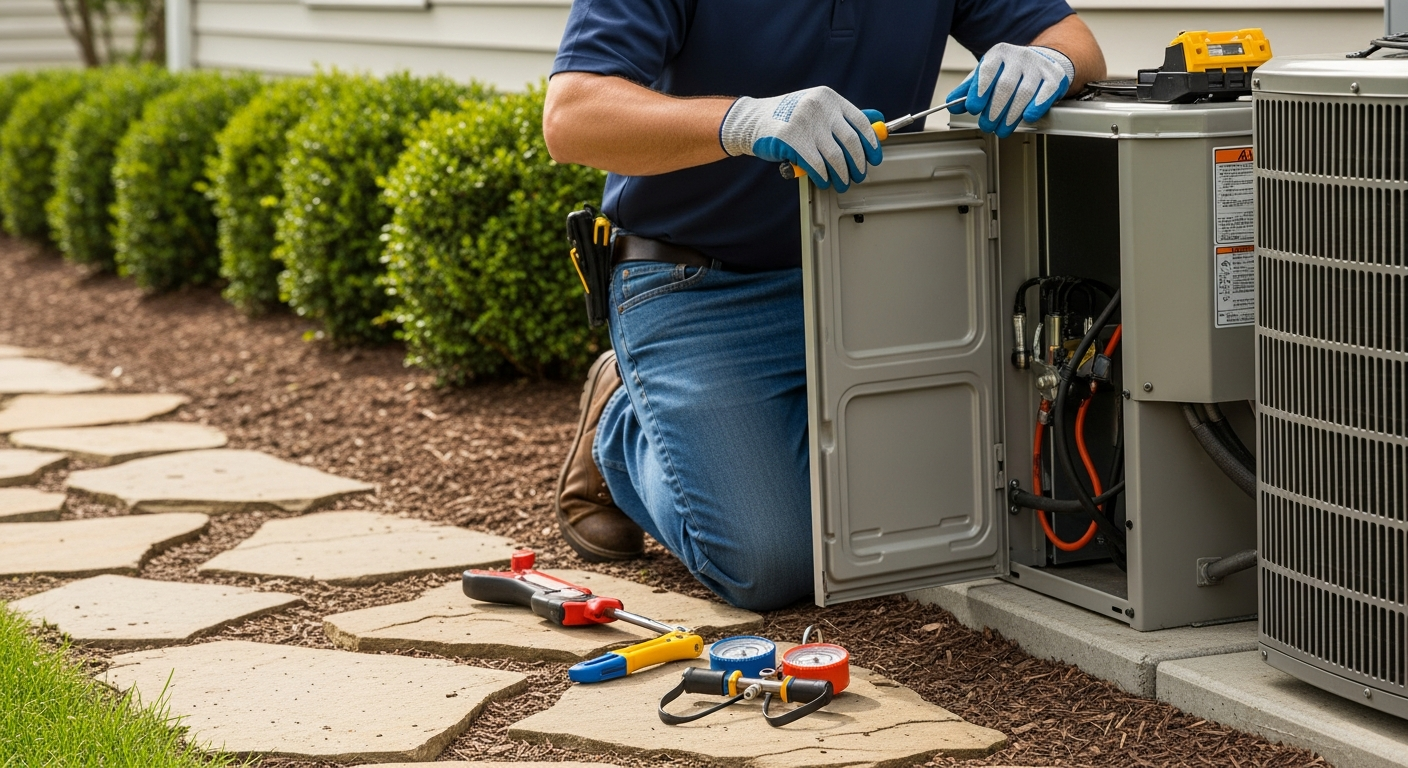
Pro-only tasks include anything involving refrigerant, gas lines, electrical panels, compressor/motor components, capacitor/contactor servicing, or disassembling the air handler. Also, mold remediation beyond a small patch (e.g., behind drywall), duct cleaning that requires professional equipment, and installation of whole-home air purifiers or dehumidifiers tied into ductwork should be handled by qualified contractors. Find vetted HVAC professionals here.
Tool & Calculator Hub: Putting Numbers Behind Your Air Quality
Use our free tools to assess your situation and estimate costs:
- Air Quality Score: Answer 10 quick questions to get a personalized IAQ risk rating and improvement recommendations.
- HVAC Cost Estimator: Get a budget range for dehumidifiers, air purifiers, ERVs, or duct services based on your region and home size.
- Repair or Replace Calculator: If your HVAC system is old and contributing to IAQ issues, see whether fixing or upgrading makes financial sense.
- Quote Checker: Upload a contractor's quote to see if it's fair for your area.
These tools use aggregated data from thousands of HVAC projects to give realistic ranges. They are not a substitute for an on-site evaluation.
Decision Guide: When to Act and What to Do
Use these concrete thresholds to decide your next move:
- Humidity > 60% for more than 24 hours: High risk of mold. Install a whole-home dehumidifier or portable units. Expect $1,200–$3,500 for a professionally installed whole-home system.
- CO2 > 1,000 ppm consistently: Inadequate fresh air. Increase ventilation with an ERV/HRV. Installation costs typically $2,500–$6,000. Learn how ERVs work.
- PM2.5 > 35 µg/m³ indoor (EPA 24-hr outdoor standard): Upgrade to MERV 13 filter; consider standalone air purifier ($200–$600) or in-duct purifier ($800–$2,500).
- Visible mold larger than 10 square feet: Professional remediation needed ($500–$6,000 depending on extent).
- Dust returns within 2 days of cleaning: Likely duct leaks or poor filtration. Start with a filter upgrade and duct inspection ($100–$350 for diagnostic).
- Musty odor from vents: Possible mold in ductwork. Professional cleaning averages $400–$1,200. Get multiple quotes via Compare Contractors.
Contractor Checklist: 8 Questions to Ask Before You Say Yes
When hiring for IAQ solutions, use this checklist to vet candidates:
- Are you certified? Look for NADCA (duct cleaning) or IAQA (indoor air quality) credentials.
- Will you perform a blower door test or duct leakage test? This quantifies air leaks that worsen IAQ.
- What's included in the duct cleaning price? Should cover supply/return ducts, grilles, coil, and blower.
- Do you provide before-and-after photos or video? Insist on documentation.
- What warranties apply? Get labor and equipment warranties in writing.
- Can you separate necessary work from nice-to-have upgrades? Avoid upsells you don't need.
- Do you carry liability and workers' comp insurance? Request proof.
- Have you successfully completed similar projects in my neighborhood? Check references or local reviews. Use our contractor search to find top-rated pros.
Local Context: Climate-Specific IAQ Traps
Hot, humid climates (Southeast, Gulf Coast): Mold and dust mites thrive. Prioritize dehumidification and A/C maintenance to keep coils clean. During vacations, set the thermostat no higher than 80°F and humidity control to <60%. Read vacation HVAC tips.
Cold climates (Midwest, Northeast): Tightly sealed homes trap VOCs and CO2. An HRV is a smart investment. Watch for window condensation in winter—it often means exhaust fans aren't used enough.
Coastal areas: Salt air corrodes HVAC components faster. Inspect outdoor units quarterly and consider corrosion-resistant coatings. High humidity requires robust dehumidification.
Older homes: Ductwork may be leaky or uninsulated, pulling pollutants from crawl spaces or attics. Prioritize duct sealing and insulating. Consider an energy audit.
Methodology: How Our Recommendations Are Built
The thresholds and advice in this article are based on:
- EPA Indoor Air Quality guidelines for particulate matter, mold, and humidity.
- ASHRAE Standards 62.1 and 62.2 for ventilation rates.
- NADCA standards for duct cleaning best practices.
- Aggregated cost data from HVACDatabase’s network of contractors, quarterly pricing surveys, and thousands of user-submitted quotes. Cost ranges reflect typical residential projects (single-family, 1,500–3,500 sq ft) and are adjusted by region. These are editorial estimates, not binding quotes.
- Clinical and epidemiological research linking indoor air pollutants to health outcomes, as referenced by the EPA and WHO.
FAQ: Your Top IAQ Questions Answered
What's the ideal indoor humidity level?
Aim for 30–50%. Below 30% can cause dry skin and respiratory irritation; above 50% encourages mold and dust mites. Use a hygrometer to monitor.
How often should I change my HVAC filter?
Check every 30 days. Basic 1-inch filters typically need replacement every 30–90 days. High-MERV 4-inch media filters can last 6–12 months. If you have pets, allergies, or live in a dusty area, replace more frequently.
Can I test indoor air quality myself?
Yes, consumer monitors (starting at $60) track PM2.5, CO2, and humidity. For mold or VOCs, professional testing is more reliable. Our Air Quality Score tool provides a quick self-assessment.
Will a whole-home air purifier solve all IAQ problems?
It helps but isn't a magic bullet. Purifiers remove particles but don't address humidity, CO2, or source control. A layered approach—ventilation, filtration, and moisture management—works best. Read our air purifier guide.
How much does it cost to improve poor indoor air quality?
Solutions range from $20 (better filter) to $6,000+ (ERV + dehumidifier + duct upgrades). The average homeowner spends $800–$2,500 on one major improvement like a dehumidifier or air purifier. Use our Cost Estimator for a personalized range.
Related articles
Connect this page to adjacent guides so readers keep moving deeper into the topic cluster.

Tips for Choosing a Smart Thermostat for a Heat Pump
Learn which smart thermostat features prevent expensive auxiliary heat mistakes, how to verify compatibility, and when to call a pro.

Understanding C Wire Adapters for Smart Thermostats
Missing the C wire for your smart thermostat? C wire adapters solve power issues without pulling new wiring. Compare types, costs, and installation options.

Best Smart Thermostats for Multi Zone Homes
Discover which smart thermostats deliver accurate zoning, remote sensors, and energy savings for homes with multiple HVAC zones. Our guide helps you pick the right model and avoid costly compatibility mistakes.