VRF vs RTU for Commercial Buildings
This decision tool compares VRF and RTU systems, covering costs, efficiency, and comfort to help commercial property owners choose the right HVAC confidently.
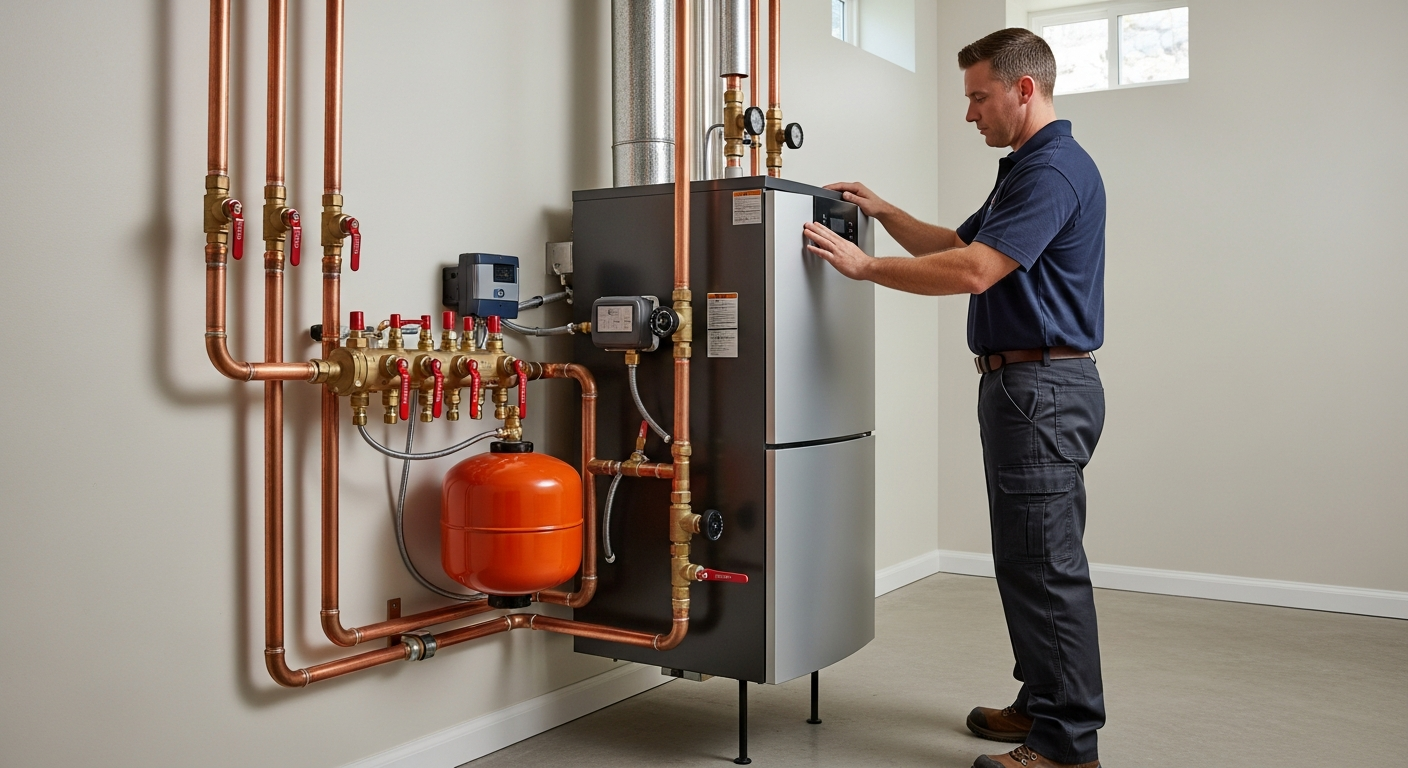
Our recommendation: Choose RTU for simplicity, VRF for efficiency
For most small to mid-sized commercial buildings with simple layouts, a rooftop unit offers the best balance of cost and simplicity. For larger, multi-zone buildings or those prioritizing comfort and energy savings, a VRF system delivers long-term value despite higher upfront cost.
What Matters Most
- Start with a load calculation (use our BTU calculator) before choosing any system.
- VRF systems can reduce energy bills by 20-40% compared to older RTUs but cost 30-50% more to install.
- If your building lacks existing ductwork, VRF avoids expensive duct installation.
- Always check ventilation requirements—VRF often needs a separate outdoor air system.
- Get 3+ quotes and use our quote checker to avoid overpaying.
Strengths
- VRF: Precision zoning, simultaneous heating/cooling, quiet operation, ductless option.
- RTU: Lower upfront cost, excellent fresh air ventilation, simple maintenance, proven reliability.
Weaknesses
- VRF: Higher repair costs, specialized technicians required, limited large-open-area application.
- RTU: Duct losses, potentially noisy rooftop fans, less efficient part-load performance.
Decision Summary: VRF or RTU?
| Scenario | Usually do | Why |
|---|---|---|
| Building under 5,000 sq ft, simple layout | RTU | Lower cost, easy maintenance, adequate for smaller spaces. |
| Large multi-zone office or hotel | VRF | Superior comfort control and energy savings across many zones. |
| Retrofit of historic building without ductwork | VRF | Minimal ductwork needed, lighter weight on structure. |
| Warehouse or high-bay space | RTU | Ducted system handles large open areas more efficiently. |
| Tight budget, short-term occupancy | RTU | Lower initial investment; efficiency gains won't offset cost. |
| Environment with simultaneous heating and cooling needs | VRF | Heat recovery can lower energy use dramatically. |
Quick Answer: VRF or RTU for Your Building?
If your building is under 5,000 sq ft, has simple zoning, and you need to control upfront costs, a rooftop unit (RTU) is often the best choice. For larger buildings (5,000+ sq ft) with many rooms that need independent temperature control—and where energy savings matter—VRF (Variable Refrigerant Flow) almost always wins despite a higher initial price. Use our BTU calculator to size your load first.
What's the Difference Between VRF and RTU?
An RTU is a self-contained packaged unit that sits on the roof and pushes conditioned air through ducts. A VRF system uses a single outdoor unit connected to multiple indoor units via small refrigerant lines, allowing each indoor unit to operate independently. This fundamental difference affects everything from installation to monthly bills.
VRF vs RTU at a Glance
| Factor | Rooftop Unit (RTU) | VRF System |
|---|---|---|
| Upfront Cost | $3,500–$7,500 per ton installed | $5,000–$12,000 per ton installed |
| Energy Efficiency | SEER 14–18 typical | SEER 18–30+ typical |
| Zoning Capability | Limited to duct layout | Precise, individual zone control |
| Noise Level | Audible outdoors; duct rumble indoors | Very quiet indoors; outdoor unit can be remote |
| Ventilation | Built-in fresh air intake | Often requires separate DOAS |
| Maintenance | Simpler, lower cost | Specialized, higher cost |
| Best For | Open areas, warehouses, budget projects | Offices, hotels, historic retrofits |
Prices are editorial estimates; get exact quotes with our cost estimator and quote checker.
Decision Rules: When to Choose Each System
Answer these simple questions to narrow your choice:
- Is your building over 5,000 sq ft with 8+ distinct zones? → VRF is likely the better fit for comfort and efficiency.
- Do you have a strict budget under $20,000 for equipment? → RTU will be more feasible.
- Does your building lack existing ductwork? → VRF avoids the expense and space of duct installation.
- Are you in a humid climate? → VRF with dedicated dehumidification often outperforms RTU in moisture control. See more in ducted vs ductless AC.
- Is fresh air ventilation a code priority? → RTU’s built-in economizer may simplify compliance.
Still unsure? Read our full guide on how to choose a commercial HVAC system.
Safety Boundaries: What You Can (and Can't) Touch
Homeowner-safe tasks: Change or clean air filters monthly, inspect visible ductwork for leaks or damage, listen for unusual noises, check thermostat settings, and keep outdoor units clear of debris.
Pro-only work (never DIY): Any refrigerant handling, electrical component replacement (capacitors, contactors, control boards), gas or combustion adjustments, compressor replacement, or high-voltage work. These tasks require licensed HVAC technicians. If you suspect a refrigerant leak or electrical fault, turn off the system and call a pro. Find a qualified contractor with our contractor search.
Contractor Checklist: What to Ask Before You Hire
- "Are you licensed and insured for commercial HVAC work in my state?"
- "Can you provide a load calculation (Manual N) and a detailed proposal?"
- "What warranties do you offer on parts and labor?"
- "How do you handle ventilation and code requirements?"
- "Will you pull all necessary permits and schedule inspections?"
- "What maintenance plan do you recommend, and what are the annual costs?"
- "Can you provide 3–5 references from similar commercial projects?"
Before you approve, run the numbers: use our repair or replace calculator if you’re replacing an existing system, and compare contractors with our comparison tool. Also, verify the system size with our BTU calculator.
Local Climate Adjustments
Hot, dry climates (e.g., Phoenix, AZ): VRF’s inverter-driven compressors handle high temperatures efficiently. Ensure outdoor units are shaded. For RTUs, oversized units will short-cycle and reduce dehumidification. See Phoenix AC contractors for local expertise.
Cold climates (e.g., Chicago, IL): VRF heat pumps can provide heat down to -13°F, but you may need supplemental heat. RTUs with gas heat exchangers are common. Check Chicago heating contractors for options.
Humid climates: VRF with a DOAS provides superior humidity control. Oversized RTUs struggle with moisture removal. Always run a load calculation to avoid oversizing.
Coastal areas: Corrosion-resistant coatings are a must for either system.
How We Form Our Recommendations
Our advice is based on industry standards (ACCA, ASHRAE), manufacturer performance data, and surveys of commercial HVAC contractors. Cost estimates are editorial ranges drawn from real project data, adjusted for region and system size. They are not guaranteed prices. Always obtain at least three quotes and verify contractor credentials.
Frequently Asked Questions
Can a VRF system replace my old RTU without major renovation?
Yes, often. VRF indoor units are small and require only refrigerant piping and small drain lines, not large ducts. This makes retrofits much less invasive, especially in historic buildings. You’ll still need a power supply and possibly a DOAS for ventilation.
Do VRF systems cost more to maintain?
Yes, typically 20–50% more per visit. VRF systems have more electronic boards, sensors, and refrigerant piping connections that require specialized training and tools. Plan on an annual maintenance agreement of $300–$600 per unit. RTU maintenance usually runs $150–$400 per year. See our guide on preventive maintenance plans.
How long do commercial VRF and RTU systems last?
Both can last 15–20 years with proper care. VRF compressors often last longer because they run at variable speeds and avoid frequent on/off cycling. However, a neglected VRF system will fail sooner and more expensively. For RTU longevity, follow our rooftop unit maintenance guide.
Is VRF worth it for a small retail store?
Usually not unless you need extreme zoning or have no ductwork. The higher upfront cost is hard to recover in a small, open space. An RTU with a simple thermostat is more cost-effective. For sizing help, use our cost estimator to compare.
Are there rebates for high-efficiency commercial HVAC?
Yes, many utilities offer substantial rebates for VRF systems that meet efficiency thresholds. RTU rebates are less common but available for high-efficiency models. Check our rebate finder to see what’s available in your area.
Methodology
HVACDatabase estimates combine common contractor price patterns, service-category pricing ranges, equipment complexity, urgency, regional labor variation, and known HVAC safety boundaries. Actual prices vary by city, brand, system size, access, warranty status, permit requirements, and whether the visit discovers ductwork, electrical, refrigerant, gas, or drainage issues. Use these numbers to sanity-check quotes, not as a guaranteed price.
Related articles
Connect this page to adjacent guides so readers keep moving deeper into the topic cluster.
Electrostatic vs Pleated HVAC Filters
Electrostatic filters are washable and budget-friendly over time, but pleated filters catch more allergens. See which fits your home's air quality and HVAC demands.

Supply vs Exhaust Ventilation Systems
Discover whether a supply or exhaust ventilation system suits your home’s climate, budget, and air quality goals. Our guide includes cost ranges, safety tips, and pro checklists.
Smart Thermostat vs Smart Vent System
Homeowners often ask: smart thermostat or smart vents? Our practical guide explains the core trade-offs, safety limits, and a clear decision path to avoid wasting money or harming your system.