Commercial HVAC Energy Saving Tips
Actionable strategies to lower commercial energy bills and improve HVAC performance. Use our tools, decision rules, and checklists to make informed upgrades and maintenance plans.
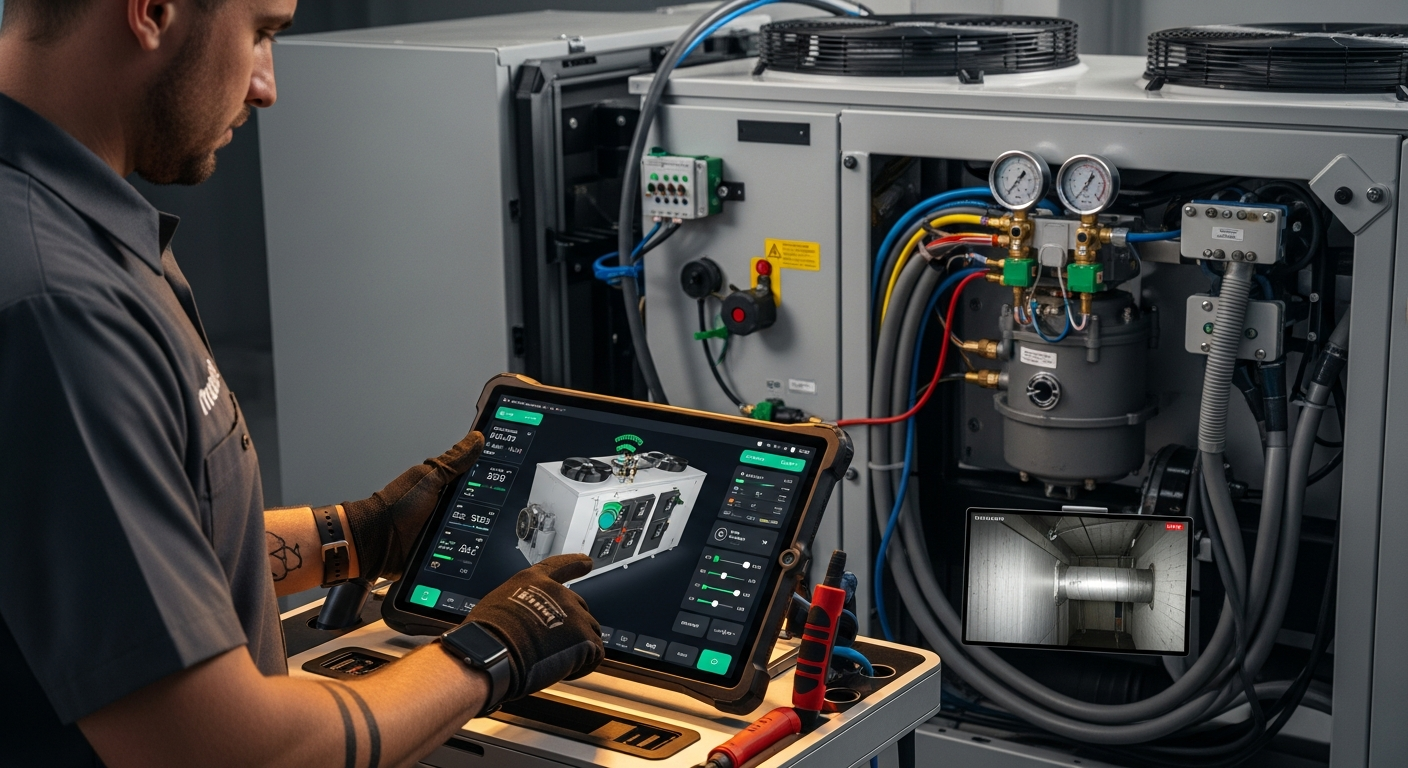
Quick Answer: High-ROI Energy Moves
- Install smart thermostats or building automation to match runtime to occupancy.
- Stick to a strict preventive maintenance schedule (filters, coils, refrigerant check).
- Seal duct leaks and building envelope gaps to stop conditioned air loss.
- Add an economizer for free cooling if your climate allows.
- Replace units older than 15 years with high-efficiency models after verifying savings.
Understand Costs and Potential Savings
Editorial estimates (not guaranteed prices): diagnostic visit $80–$200; maintenance visit $80–$250; common repairs $150–$650 to $1,500+; full system replacement $8,000–$25,000+. Use tools below to estimate your building's savings.
| Upgrade | Typical Cost Range | Estimated Annual Savings | Payback Period |
|---|---|---|---|
| Programmable smart thermostat | $150–$800 installed | $180–$600 | 0.5–2 years |
| Duct sealing (professional) | $1,200–$3,500 | $300–$900 | 2–5 years |
| Economizer addition | $800–$2,500 | $200–$600 | 2–4 years |
| High-efficiency unit replacement | $8,000–$25,000+ | $800–$2,500 | 5–12 years |
Actual savings vary by climate, building size, and utility rates. Use our energy calculator and cost estimator for tailored numbers.
Safety Boundaries: What Property Managers Can Check (and What Requires a Pro)
Safe DIY Checks
- Inspect and change air filters monthly (or per schedule).
- Check thermostat calibration using an independent thermometer.
- Visual inspection of ductwork for loose connections or visible gaps.
- Verify that outdoor unit area is clear of debris and vegetation.
- Inspect weatherstripping around doors/windows.
Work That Must Be Left to Licensed HVAC Technicians
- Refrigerant handling or leak repair—requires EPA certification.
- Electrical component replacement (capacitors, contactors, circuit boards).
- Compressor or motor work.
- Combustion system or gas line adjustments.
- Any task that involves opening the sealed refrigeration circuit or high-voltage panels.
If you suspect these issues, find a qualified contractor immediately.
Decision Rules: Tune-Up, Retrofit, or Replace?
Use these thresholds to decide next steps:
If your system is under 10 years old and bills are rising
Start with low-cost measures: replace filters, clean coils, inspect ductwork for obvious leaks. Schedule a professional tune-up (about $150–$250) and install a smart thermostat.
If your system is 10–15 years old and needs major repairs
Get a repair estimate and compare against the cost of a new unit using our repair or replace calculator. If the repair exceeds 30% of replacement cost, replacement usually wins.
If your system is over 15 years old
Plan for replacement with a high-efficiency model. Use the BTU calculator to size properly and the cost estimator to budget. Look for rebates via our rebate finder.
If you have uneven temperatures
First, check for blocked vents, dirty filters, and thermostat placement. Then hire a pro to test duct leakage and balance airflow. Often a duct sealing job solves the problem for far less than replacing equipment.
Use Our Tools to Avoid Guesswork
HVACDatabase offers free calculators to sharpen your decisions:
- HVAC Cost Estimator: Get localized installation cost ranges.
- Repair or Replace Calculator: Input age, repair cost, and efficiency to see which option makes financial sense.
- Energy Savings Calculator: Compare running costs of old vs. new equipment.
- Rebate Finder: Check utility and federal incentives for efficient upgrades.
- System Age Decoder: Decode your unit’s serial number to confirm age.
Local Climate Considerations
Your region shapes the best strategy:
- Hot, dry climates (e.g., Phoenix): Prioritize high-SEER AC, economizers for shoulder seasons, and keeping condenser coils clean. Find Phoenix pros.
- Hot, humid climates (e.g., Southeast US): Focus on dehumidification; consider dedicated outside air systems. Avoid oversizing—it short cycles and leaves air clammy. Use our BTU calculator.
- Cold climates (e.g., Chicago): High-efficiency gas furnaces or cold-climate heat pumps pay back faster. Regular maintenance on heat exchangers critical. Chicago heating contractors.
- Coastal or corrosive environments: Specify corrosion-resistant coils and coatings. Frequent coil cleaning is mandatory.
- Older buildings: Check for asbestos or outdated wiring before major retrofits. Duct replacement may be needed if heavily deteriorated.
Contractor Checklist: Questions to Ask Before You Approve Work
Use this checklist to vet any HVAC contractor proposing energy upgrades. Read our full guide.
- Are you licensed, bonded, and insured? Request proof. Most states require specialty HVAC licenses.
- Will you perform a load calculation (Manual J or equivalent) before sizing new equipment? Never accept rule-of-thumb sizing.
- Do you guarantee your work and offer a service contract? Get warranty terms in writing.
- Can you provide a detailed breakdown of equipment and labor costs? Compare multiple quotes with our Quote Checker.
- What specific efficiency rating (SEER2, EER2, HSPF2) will the new system achieve? Ask for AHRI certificate.
- Will you test and report duct leakage after sealing? A good contractor measures before/after.
- Do you participate in local utility rebate programs? They should help you file paperwork.
- What is the projected annual energy savings based on your building’s usage? Get it in writing.
Methodology: How We Form Recommendations
This guide synthesizes Department of Energy benchmarks, ASHRAE standards, and real-world contractor pricing data. All cost ranges are editorial estimates based on national averages; actual costs vary by region, complexity, and market conditions. Savings projections assume typical commercial building usage patterns and are not guaranteed. Always obtain multiple bids and verify with our calculators.
Frequently Asked Questions
How much can a programmable thermostat really save?
Properly scheduled setbacks can reduce HVAC runtime by 10-30%. In dollar terms, a typical small commercial building saves $180–$600 annually. The exact figure depends on occupancy patterns and climate.
Is duct sealing worth it if my building is old?
Yes—leaky ducts waste the conditioned air you already paid to heat or cool. Professional duct sealing recovers 20-30% of lost airflow, often paying back in 2-5 years. Note: if ducts contain asbestos, abatement may be needed first.
When should I consider replacing my HVAC instead of repairing?
The 50/50 rule: if a repair costs more than 50% of a new unit AND the unit is over 10 years old, replacement usually wins. Use our repair/replace calculator for a precise analysis.
What is an economizer and do I need one?
An economizer uses outdoor air for cooling when outside conditions are favorable. It can reduce compressor use by 30-60% in spring and fall. Best suited for climates with cool nights/mild seasons. Learn more about system options.
Can I just hire any HVAC company for commercial work?
No. Commercial systems differ from residential in scale, controls, and code. Look for a contractor with specific commercial experience, NATE or equivalent certifications, and references from similar buildings. Our contractor comparison tool can help.
Related articles
Explore related maintenance, equipment, and hiring questions.

Nest Learning Thermostat (4th gen) vs ecobee Premium
Both models offer remote room sensors. Compare the exact generation, wiring compatibility, controls, and installed quote before choosing.

MERV 11 vs MERV 13: check filtration and equipment compatibility
Compare particle filtration, verify the filter your equipment supports, and use a buying checklist without assuming a universal health or energy saving.

How to check an HVAC contractor before hiring
Use a documented shortlist: business identity, applicable credentials, job experience, a written scope, and a clear handover.