Why Your AC Is Running Constantly
Discover why your air conditioner runs nonstop, from dirty filters to undersized units, and get a step-by-step decision guide to lower bills and stop the endless hum.
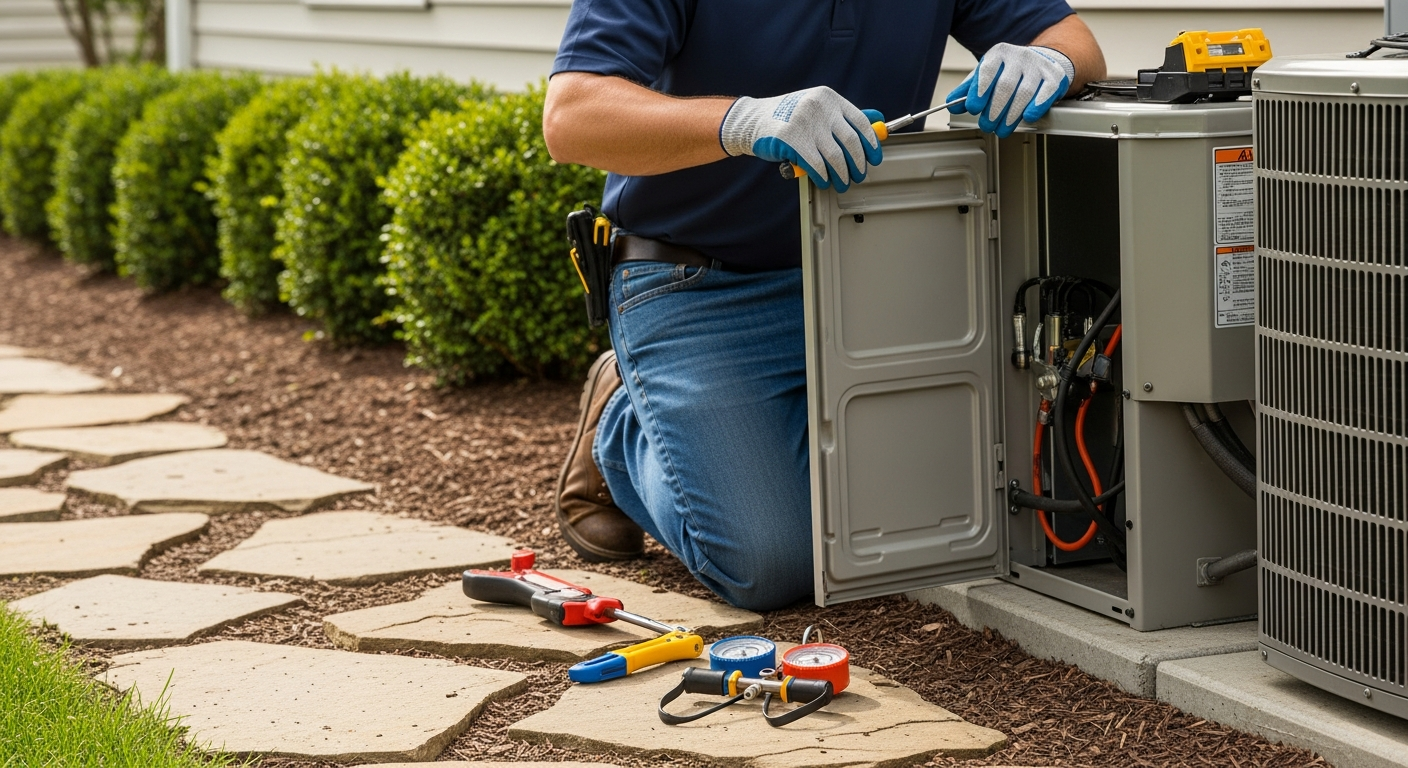
Quick Answer: Why Your AC Runs Without Stopping
A constantly running air conditioner is almost always a sign it’s struggling to meet your home’s cooling demand. The culprit could be as simple as a thermostat fan set to “ON” or a clogged filter, or as serious as low refrigerant, leaky ducts, or an undersized unit. Start with the no-cost checks below before calling a technician. If the system is over 12 years old and needs a repair costing more than $1,500, replacement may be cheaper in the long run. Use our Repair-or-Replace Calculator to compare options.
1. Start With What You Can Safely Check
These homeowner-level checks fix the majority of constant-run issues and cost little to nothing.
- Thermostat fan setting: Switch the fan from “ON” to “AUTO.” In “ON” mode the blower runs 24/7 even when the AC isn’t cooling. If the house feels cool but the hum never stops, this is likely the fix.
- Air filter: A dirty filter starves your system of airflow, making it run twice as long to do its job. Check monthly and replace if it looks gray or dusty. Learn how to replace your AC filter.
- Outdoor condenser: Debris, grass clippings, or leaves can choke the outdoor unit. Gently rinse the fins with a garden hose on low pressure (unit off) to restore heat release. See coil cleaning tips.
- Drain line: If water collects around the indoor unit, the condensate drain may be clogged. Pouring a cup of white vinegar down the line can clear minor blocks. For more persistent issues, read how to fix a leaking condensate drain pan.
2. When the Problem Is Bigger Than a Filter
If the quick fixes don’t solve the constant running, the cause likely needs professional diagnosis. Below are the most common pro-level issues and their telltale signs.
| Symptom | Likely Cause | What to Do |
|---|---|---|
| AC runs but weak airflow from vents | Frozen evaporator coil (low airflow or refrigerant) | Turn system off immediately to let ice melt; call a pro |
| Ice on indoor or outdoor copper lines | Low refrigerant or leak | Do not run; contact a licensed contractor |
| Hissing or bubbling noise | Refrigerant leak | Schedule a service call—refrigerant handling requires EPA certification |
| House never reaches set temp on hot days | Undersized unit or huge duct leaks | Use BTU Calculator; get a Manual J load calculation from a contractor |
| System over 15 years, frequent repairs | Age-related efficiency loss | Consider replacement; check System Age Decoder |
Safety Boundaries: What You Should Never DIY
Homeowners can safely inspect thermostats, change filters, clean outdoor fins with water, clear obvious drain clogs, and look for visible duct disconnects. Never attempt to:
- Add or recover refrigerant—it’s regulated and requires specialized tools.
- Open electrical panels, replace capacitors, contactors, or control boards.
- Test or repair compressors, gas lines, or combustion components.
- Bypass safety switches (float switches, high-pressure cutoffs).
If you suspect any of these, find a vetted local contractor through our contractor search or compare bids with our contractor comparison tool.
Decision Tree: Is It an Emergency or a Tune-Up?
Use these thresholds to decide how quickly to act.
- Ice anywhere on the system → Emergency. Turn off, call pro within 24 hours.
- Water leaking indoors → Urgent. Shut off, clear drain yourself or call pro.
- Unit runs constantly but house is comfortable → Non-urgent. Check fan setting and thermostat placement; schedule maintenance if it persists.
- Unit runs constantly and house is too warm → Priority. Check filter, then call pro if filter change doesn’t help.
- Unit is over 12 years old and repair estimate exceeds $1,500 → Replacement likely a better investment. Use Repair-or-Replace Calculator.
Costs to Expect: Diagnostic, Repair, or Replacement
All ranges are editorial estimates based on U.S. averages. Regional labor, seasonal demand, and brand can shift prices significantly.
| Service | Estimated Cost Range | Notes |
|---|---|---|
| Diagnostic service call | $80 – $200 | Often waived if you proceed with repair |
| Standard maintenance visit | $80 – $250 | Annual plans often run $150–$500 |
| Minor repair (capacitor, contactor, drain) | $150 – $650 | Includes small electrical or control parts |
| Mid-size repair (refrigerant leak fix, fan motor) | $500 – $1,500 | Evacuation, recharge, leak seal |
| Major repair (compressor, coil replacement) | $1,500 – $4,000+ | Often not worth it on units 12+ years |
| Full system replacement | $5,000 – $12,000 | Varies by SEER, size, ductwork needs |
Always get at least three itemized quotes. Use our Quote Checker to evaluate fairness.
Use Our Free Tools Before You Decide
- BTU Calculator – Check if your unit is sized correctly for your home’s square footage and climate.
- System Age Decoder – Confirm the manufacture date using the serial number.
- Repair-or-Replace Calculator – Plug in age, repair cost, and efficiency to see the numbers.
- HVAC Cost Estimator – Get a personalized replacement cost ballpark.
- Rebate Finder – Locate utility or federal incentives for high-efficiency ACs.
Contractor Checklist: What to Ask Before Hiring
Before you approve any work, ask these questions to avoid overspending or shoddy jobs.
- Are you licensed and insured in my state? (Ask for proof)
- Will you provide a detailed written estimate with parts, labor, and timeline?
- Do you perform a Manual J load calculation before recommending a new system size?
- What warranties do you offer on parts and labor?
- Can you show me the EPA certification for refrigerant handling?
- Do you have references from similar homes in my area?
- Are there any rebates or financing options I should know about?
Find prescreened contractors at HVACDatabase Search or see example pros in Phoenix or Chicago.
Local Factors That Change the Math
Hot climates (Phoenix, Las Vegas): Even a properly sized unit may run 12+ hours on 110°F days. Insulation and radiant barriers matter as much as the AC itself.
Humid climates (Houston, Miami): A system that short-cycles won’t dehumidify well. A slightly longer runtime—especially with a variable-speed unit—can improve comfort. Consider a whole-home dehumidifier if humidity remains high despite cooling.
Older homes (pre-1980s): Duct leaks of 20–30% are common. Sealing ducts can be cheaper and more effective than upsizing the AC. Inspect visible ducts yourself or hire a duct-blaster test.
Coastal areas: Salt air corrodes condenser coils, shortening lifespan by 5–7 years. Ask contractors about coated or copper condenser coils when replacing.
Methodology: How We Arrived at These Recommendations
Frequently Asked Questions
Why does my AC run constantly on hot days?
When outdoor temperatures exceed 95°F, a properly sized AC may run almost continuously during peak afternoon hours. This is normal if the home eventually reaches the set point by evening. If it never cools to the target temperature even at night, the system may be undersized or have a refrigerant/airflow problem.
Can a dirty filter really cause constant running?
Absolutely. A severely clogged filter can reduce airflow by 50% or more, dramatically cutting the system’s cooling capacity. The AC compensates by running longer cycles. A $15 filter change can prevent a $300 diagnostic call.
Is it okay to run my AC 24/7 if it’s cooling fine?
Continuous operation adds wear and increases energy use, but if the system is cycling off occasionally and maintaining comfort, it may be acceptable during extreme heat. However, if it truly never turns off, have it inspected to avoid premature compressor failure.
How do I know if my AC is too small for my house?
Use our BTU Calculator to estimate the cooling capacity your home needs. If your existing unit’s tonnage is significantly below the recommendation, it’s likely undersized. Classic signs: inability to cool on design-temperature days, long runtimes, and elevated electric bills.
What’s the average lifespan of an AC that runs constantly?
A well-maintained central AC lasts 15–20 years. Constant runtime due to a mismatch or neglect can shorten that to 8–12 years. Regular filter changes and annual professional maintenance are the best ways to counter the extra wear.
Related articles
Explore related maintenance, equipment, and hiring questions.

Nest Learning Thermostat (4th gen) vs ecobee Premium
Both models offer remote room sensors. Compare the exact generation, wiring compatibility, controls, and installed quote before choosing.

MERV 11 vs MERV 13: check filtration and equipment compatibility
Compare particle filtration, verify the filter your equipment supports, and use a buying checklist without assuming a universal health or energy saving.

How to check an HVAC contractor before hiring
Use a documented shortlist: business identity, applicable credentials, job experience, a written scope, and a clear handover.