How to Size a Commercial HVAC System
Sizing commercial HVAC correctly prevents high energy bills and comfort issues. This guide covers load calculations, equipment options, and a contractor checklist to help you get the right capacity.

Get a Manual N Load Calculation, Then Compare Bids
For any commercial building over 5,000 sq ft or with complex occupancy, hire a licensed professional to perform a Manual N load calculation. Use our tools to verify the sizing and cost fairness before committing.
What Matters Most
- Commercial sizing is not a DIY task; insist on Manual N.
- Oversizing hurts comfort, efficiency, and equipment life.
- Use our BTU and cost tools to audit contractor proposals.
- Factor in ventilation, internal loads, and local climate.
- Regular maintenance preserves the capacity you paid for.
Strengths
- Reduces energy waste and long-term maintenance costs.
- Improves tenant comfort and productivity.
- Aligns with energy codes and unlocks utility incentives.
Weaknesses
- Professional load calculation fees ($500–$2,000) add upfront planning cost.
- Correct sizing may reveal need for ductwork upgrades, raising total project cost.
- Unique or custom spaces still require specialized engineering input.
Decision Summary
| Scenario | Usually do | Why |
|---|---|---|
| Small retail (<2,000 sq ft) | Split system or small RTU | Cost-effective, single zone adequate |
| Large warehouse (20,000+ sq ft) | High-volume RTU or chiller | Covers large open area, often with high ceilings |
| Restaurant | Dedicated outdoor air system (DOAS) + RTU | High occupancy and cooking loads demand ventilation control |
| Office with dense IT equipment | VRF with per-zone control | Precise temperature management, low noise |
| Historic building | Mini-splits or low-profile ducted | Preserves architecture, minimizes ductwork intrusion |
Why Commercial HVAC Sizing Is Different
Commercial spaces aren’t just bigger homes. They have higher occupant density, heat-generating equipment, and strict ventilation codes. A correctly sized system matches your building’s exact cooling and heating loads—not a rule of thumb. Oversizing leads to short cycling, sticky humidity, and wasted energy. Undersizing means constant runtime, premature part failures, and tenant complaints. This guide gives you the decision framework, tools, and contractor questions to get commercial sizing right the first time.
Quick Answer: How to Size a Commercial HVAC System
Follow these steps: (1) Measure total square footage and ceiling height to find conditioned volume. (2) Document internal heat sources—people, lights, computers, cooking equipment. (3) Note window area, orientation, and shading. (4) Have a licensed professional perform a Manual N load calculation—this is the industry-standard method for commercial buildings. (5) Add required outdoor ventilation air (per ASHRAE 62.1). (6) Select equipment whose sensible and latent capacities meet the calculated load. (7) Verify existing ductwork can handle the required airflow. Our BTU calculator gives a rough budget estimate, but only a Manual N report can guarantee accuracy.
Key Factors That Determine Cooling and Heating Load
Every piece of your building affects the load. Here’s what a Manual N calculation accounts for:
- Square footage & ceiling height: Taller ceilings mean more air volume to condition—expect 15–30% higher BTUs than a standard 8-ft ceiling.
- Occupancy: Each person adds 200–250 BTUs of sensible heat plus latent (moisture) load.
- Equipment & lighting: Data centers, commercial kitchens, and dense office equipment can dominate the cooling load.
- Windows: Solar heat gain through glass, especially south- and west-facing, can double the cooling demand in perimeter zones.
- Building envelope: Insulation levels, roof color, and air leakage determine how much outdoor heat sneaks in.
- Ventilation: Bringing in fresh outdoor air mandatory under code adds a sizable conditioning load that must be included.
Commercial HVAC Equipment Types at a Glance
| Equipment | Best for | Typical Cost per Installed Ton* | Key Consideration |
|---|---|---|---|
| Rooftop Unit (RTU) | Low-rise offices, retail, warehouses | $2,800–$4,500 | Packaged, easy to service; single zone unless multizone |
| Split System | Restaurants, small professional offices | $3,000–$5,200 | Quiet indoor air handler; can be placed inside |
| VRF/VRV | Hotels, mixed-use, schools | $4,000–$6,500 | Superior zoning, very efficient; higher first cost |
| Chiller + Air Handlers | Large campuses, hospitals, high-rises | $5,000–$8,000+ | Centralized, scalable; complex maintenance |
*Editorial estimates based on industry surveys; final pricing depends on region, labor, and project specifics. Use our cost estimator for a local range.
Safety Boundaries: What You Can (and Cannot) Do
Safe checks for property owners/managers:
- Look for uneven temperatures, persistent drafts, or musty odors that signal airflow or humidity issues.
- Monitor monthly energy bills for sudden spikes.
- Visually inspect filters, condensate drains, and accessible ductwork for blockages or leaks.
- Measure room dimensions, count occupants, and list all heat-producing equipment to share with your contractor.
Leave to licensed professionals:
- Manual N load calculation and equipment selection.
- Any work involving refrigerants, natural gas, high-voltage electricity, or sealed components.
- Duct design modifications or sizing.
Never attempt to adjust refrigerant charge, open compressor wiring, or bypass safety controls. For all repairs, hire a qualified technician. Use our contractor search to find vetted pros in your area.
Use HVACDatabase Tools to Plan Your Project
Build knowledge and budget before you call contractors:
- BTU Calculator: Rough cooling/heating estimate based on square footage. Try it
- Cost Estimator: Localized price range for your building type. Start now
- Quote Checker: Upload a contractor bid to see if it’s fair. Review your quote
- Rebate Finder: Discover utility incentives for efficient commercial equipment. Find rebates
Decision Tree: How to Choose the Right System Size
Click to expand decision steps
- Building over 5,000 sq ft or complex occupancy? → Requirement: Professional Manual N calculation. Rules of thumb are not enough. Find a commercial specialist.
- Humidity control critical? (e.g., restaurant, indoor pool) → Avoid oversizing. Select variable-capacity equipment or dedicated dehumidification. Slightly undersized can improve moisture removal.
- Ceilings higher than 12 ft? → Use total volume, not just floor area. Expect 15–30% higher BTU needs. Discuss with your engineer.
- Building in a heating-dominated cold climate? → Balance heat pump sizing with backup heat. Oversizing for heating can ruin cooling comfort. Consider dual-fuel. Choosing a commercial system
- Replacing an existing system? → Inspect ductwork: can it handle new airflow? Older buildings may need envelope upgrades before resizing. Duct inspection tips
Contractor Checklist: Questions to Ask Before Approving a Commercial HVAC Installation
Print or save this list. A qualified contractor will answer “yes” to every point.
- Will you perform a Manual N load calculation and share the detailed report? Demand room-by-room heat gains/losses, outdoor design conditions, and final equipment selection logic.
- Are you licensed and insured for commercial HVAC work in this state? Verify independently at your state licensing board.
- How many similar projects have you completed in the last three years? Ask for references, especially for your building type.
- Do you provide a financial analysis comparing equipment tiers? High-efficiency units often qualify for rebates. Check rebates.
- What are the parts and labor warranty terms? Do you offer a preventive maintenance plan? Clear warranties protect your investment. See maintenance plans.
- Will you evaluate existing ductwork, insulation, and controls? Total system static pressure and zoning must match the new equipment.
- Can you provide a performance guarantee or energy model? For larger projects, this de-risks the ROI.
- Does the bid include setup for IoT monitoring or remote alerts? Proactive monitoring cuts surprise repair costs. Factor into your budget.
Local Considerations: Climate and Building Type Matter
Hot/Humid Climates (e.g., South Florida, Houston)
Prioritize latent capacity. Varable-speed equipment is ideal. Consider supplemental dehumidification for fresh air. Oversizing here is especially damaging. Roof unit maintenance in humidity.
Hot/Dry Climates (e.g., Phoenix)
High SEER ratings pay back quickly. Evaporative pre-coolers can reduce compressor load. Find local pros: Phoenix AC contractors.
Cold Climates (e.g., Chicago, Minneapolis)
Heating efficiency (HSPF, AFUE) is paramount. Dual-fuel heat pump systems avoid oversized AC. Schedule annual heat exchanger checks. Chicago heating experts.
Coastal Areas (e.g., Los Angeles, Seattle)
Salt haze corrodes coils. Specify coastal-rated coatings and stainless-steel hardware. Mild ambient air allows many free-cooling hours—factor economizers into the load calc.
Older Buildings (pre-1980)
Original load calculations are outdated. Envelope improvements (insulation, windows) reduce load; balancing ductwork and pressure become critical. Choosing a contractor for historic buildings.
Methodology: How Our Estimates Are Formed
HVACDatabase cost ranges and sizing recommendations draw on aggregated contractor pricing surveys, RSMeans data, utility rate schedules, and manufacturer suggested prices. Load calculation guidance follows ACCA Manual N and ASHRAE Fundamentals. Editorial estimates are refreshed quarterly. Actual costs vary by region, labor rates, material availability, and project complexity. Always obtain three competitive bids and use our quote checker to assess fairness.
Frequently Asked Questions
1. Can I size a commercial HVAC system with an online BTU calculator?
Online tools give a rough (±20%) budget estimate. They cannot replace a Manual N load calculation, which factors orientation, internal gains, and ventilation. Use our BTU calculator as a starting point, then hire a pro to validate.
2. What’s the cost difference between a rooftop unit and a VRF system per ton?
Installed costs for RTUs run $2,800–$4,500/ton; VRF systems typically $4,000–$6,500/ton. VRF offers 15–30% energy savings and superior zoning, often improving payback in mixed-use buildings. Get a tailored estimate with our cost estimator.
3. How often should I redo a load calculation?
Perform a new Manual N when you expand, change occupancy density, install significant heat-producing equipment, or upgrade the building envelope. For stable buildings, every 15–20 years accounts for climate and equipment efficiency changes.
4. Is it better to oversize or undersize a commercial AC?
Neither. Oversizing short-cycles, fails to dehumidify, and costs more upfront. Undersizing leaves spaces uncomfortable and wears out equipment. In humid climates, a slight undershoot with variable capacity is safer; in dry climates, a slight overshoot may be tolerable if airflow is matched. Precision is worth the effort.
5. What maintenance keeps a correctly sized system performing well?
Quarterly filter changes, annual coil cleaning, belt tension checks, and IoT performance tracking help retain 95–100% of original capacity over a decade. Start with a preventive maintenance plan.
Related articles
Connect this page to adjacent guides so readers keep moving deeper into the topic cluster.
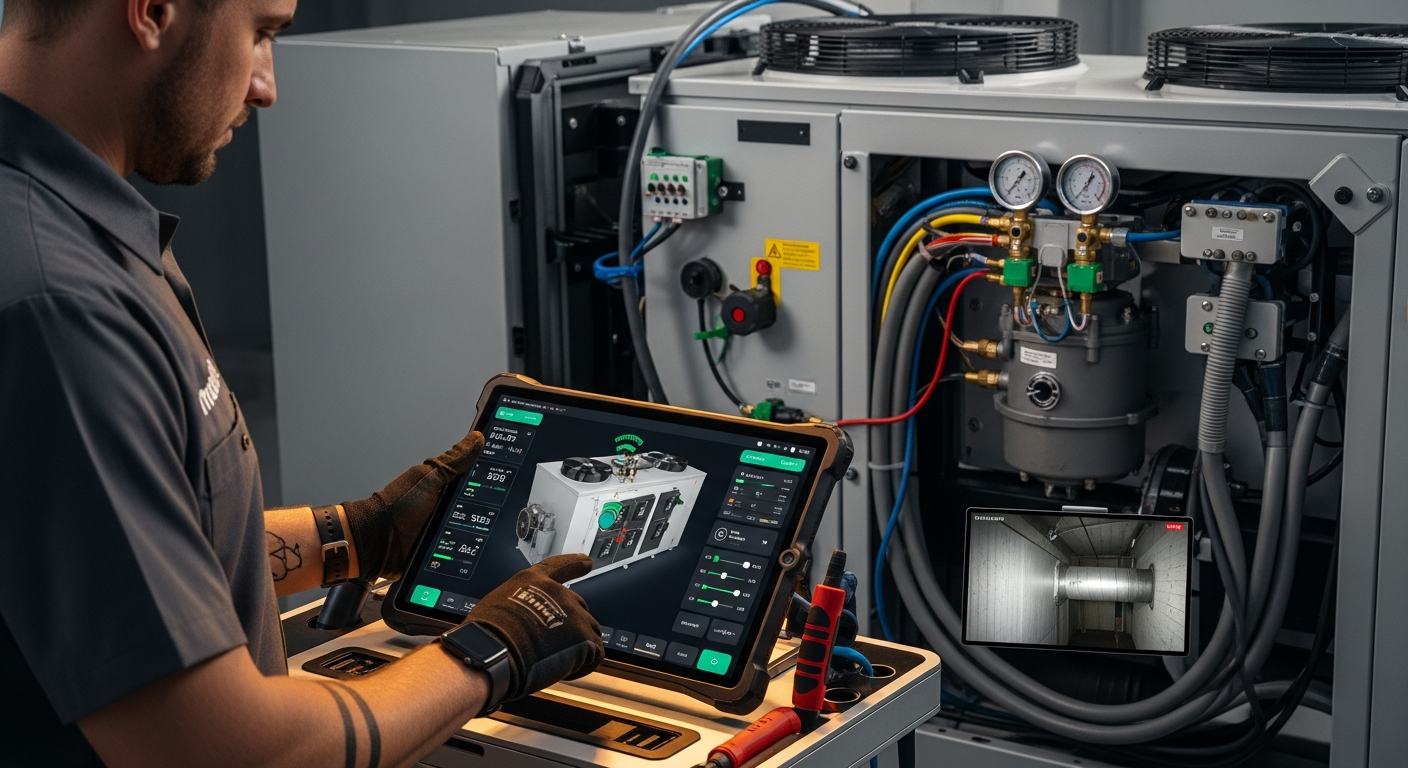
How to Implement a Whole Home Energy Management System
Integrate smart tech and HVAC controls to cut energy waste. This guide shows how to audit, upgrade, and automate your home's energy use, with real savings estimates.

How to Set Up Thermostat Geofencing
Set up thermostat geofencing to automatically adjust home temperature as you come and go. Save energy, extend equipment life, and never return to an uncomfortable house. Get our quick-start guide now.
How to Troubleshoot Smart Thermostat WiFi Issues
Your smart thermostat offline? Most WiFi drops can be fixed with power checks, router adjustments, and simple restarts. Follow our step-by-step guide to regain remote control and energy savings.