When DIY HVAC Repairs End Up Costing More
Many HVAC repairs require EPA certification, special tools, and deep knowledge. This guide separates safe DIY maintenance from costly mistakes, helping you decide when to hire a pro and what questions to ask.
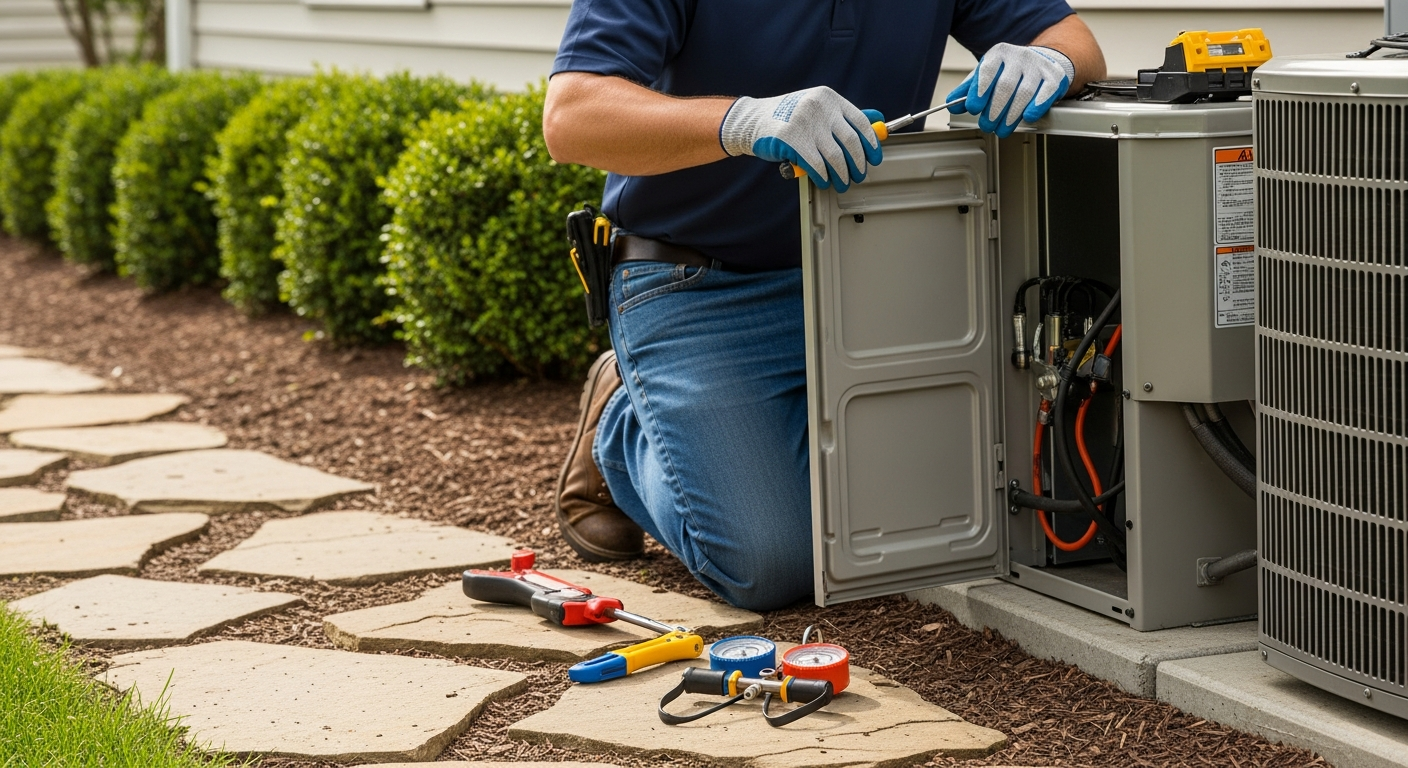
It starts with a YouTube video and good intentions: you can save a few hundred bucks by fixing that odd furnace noise yourself. But HVAC systems aren’t like faucets or light switches. One wrong capacitor, a refrigerant leak, or an unseated gas valve can trigger a chain of failures that cost thousands. This guide shows you where the line is between safe DIY upkeep and dangerous territory—and how to find a pro you can trust.
Quick Answer
Is DIY HVAC repair worth the risk?
No—unless it’s a basic maintenance task like changing a filter or cleaning coils. For anything involving refrigerants, gas, high-voltage electricity, or sealed system components, the cost of a mistake often exceeds professional fees. A misdiagnosis can turn a simple fix into a system-wide breakdown, void your warranty, or cause safety hazards. Use our HVAC cost estimator to see what a pro repair should cost before deciding.
Safety Boundaries: What You Can (and Can’t) Touch
Safe Homeowner Checks
- Replacing air filters (see guide)
- Clearing debris from outdoor condenser unit
- Checking thermostat settings and batteries
- Pouring vinegar down condensate drain to prevent clogs (how-to)
- Visual inspection of duct registers for obvious blockages
Strictly Pro-Only Work
- Refrigerant leak repair or recharging (requires EPA 608 certification)
- Any task involving natural gas or propane connections
- High‑voltage electrical components: capacitors, contactors, control boards
- Compressor replacement or sealed system opening
- Furnace heat exchanger inspection or combustion analysis
- Anything that requires a multimeter beyond battery voltage checks
How DIY Fixes Become Four‑Figure Problems
| DIY Attempt | Typical Mistake | Potential Added Cost |
|---|---|---|
| Replacing a run capacitor | Wrong microfarad rating or voltage spec | Burn out compressor or fan motor: $1,500–$4,000+ |
| Clearing a clogged drain line | Using high‑pressure air without proper safety, blowing apart PVC joints | Water damage to ceilings/walls and mold remediation: $500–$5,000 |
| Topping off refrigerant (illegal) | Overcharging or mixing refrigerants, leading to compressor failure | Compressor replacement + proper evac/recharge: $2,000–$5,000 |
| Replacing a furnace ignitor | Installing incorrect model; gas valve timing issues | Gas leak or carbon monoxide risk + board damage: $800–$2,500 |
| Tightening a loose electrical connection | Shorting wires, frying control board | New control board + labor: $500–$1,200 |
Editorial estimates; actual costs vary by region and equipment. Use our cost estimator for personalized figures.
Decision Rules: Should You DIY or Dial?
Ask yourself these questions. If you answer “yes” to any of the first three, call a pro.
Decision Flow (click to expand)
- Is refrigerant involved? Yes → Pro. It’s illegal and dangerous without EPA certification.
- Are you opening the sealed cabinet of a furnace or AC? Yes → Pro. Internal components carry shock, gas, and burn risks.
- Do you smell gas or hear hissing? Yes → Evacuate and call your utility and an emergency HVAC pro.
- Is the system still under warranty? Yes → Pro. DIY voids most manufacturer warranties.
- Does the fix require a tool you don’t own? Yes → Pro. The right diagnostic gear (manometer, micron gauge, combustion analyzer) costs thousands.
- Is it strictly a cleaning or filter task? Yes → DIY with common tools and proper safety.
- Does the problem recur within days of your fix? Yes → Pro. You missed the root cause.
Use Our Calculators Before You Call
Get a realistic price range so you aren’t caught off guard. These free tools estimate costs based on your zip code, equipment, and local labor rates:
- HVAC Cost Estimator – ballpark for repairs, maintenance, or full system replacement
- Repair or Replace Calculator – if your unit is over 10 years old, see if replacement makes more sense
- Quote Checker – upload a contractor bid and see if it’s fair
Contractor Checklist: 8 Questions Before You Approve Work
- Are you licensed and insured in this state? Ask for the license number and verify it online.
- Do you have EPA Section 608 certification for refrigerant work? Request proof if the job involves AC.
- Will you provide a written, itemized quote before starting? Insist on seeing parts and labor broken down.
- Is this repair covered by a warranty, and for how long? Get details on both parts and labor guarantees.
- Do you pull permits when required? For major replacements, a permit protects you and the homeowner.
- Can you show me photos of the failed part? A reputable tech will document the issue.
- What is your diagnostic fee policy? Standard visit runs $80–$200; some apply it to the repair if you proceed.
- Do you offer a maintenance plan? Annual plans ($150–$500) often include priority service and discounts.
Local Factors That Affect Your Decision
Your climate and home age can tip the scales toward professional help:
- Hot/Humid (Southeast, Gulf Coast): AC downtime can cause mold within 48 hours. Don’t risk a repair delay.
- Cold (Midwest, Northeast): A botched furnace repair can lead to frozen pipes and carbon monoxide poisoning. Never DIY gas work.
- Coastal (salt air): Corroded coils and connections require special handling; DIY cleaning can worsen damage.
- Older homes (pre‑1990): Asbestos duct wrap, outdated wiring, and incompatible refrigerants demand a pro who knows code.
Find a licensed contractor who understands your region: search by zip code or compare top-rated pros on our comparison page.
How We Develop Our Recommendations
Frequently Asked Questions
Can I replace my own AC capacitor?
Technically possible, but highly discouraged. Capacitors store high voltage even when the power is off and require exact microfarad matching. The wrong spec can destroy your compressor or fan motor, instantly multiplying the repair cost 10‑fold. Hire a pro—this repair typically costs $150–$400 including the part.
What happens if I accidentally let refrigerant escape?
You’re legally required to report it, and the EPA can fine up to $37,500 per day. More importantly, refrigerant loss reduces efficiency and can damage the compressor. A certified tech must find the leak, repair it, and recharge with the correct type and amount. Average cost for leak repair and recharge: $500–$1,500.
My furnace has a flashing error code. Can I fix it myself?
You can record the code and check simple things—like a dirty filter or blocked intake—but error codes are often symptoms, not the root cause. For example, a pressure switch fault might stem from a clogged condensate trap, a failing inducer motor, or a cracked heat exchanger. Let a pro run a safety diagnostic (typical visit fee $80–$200). Learn more in our pre‑call inspection guide.
Will my home insurance cover DIY damage?
Almost certainly not. Most policies exclude damage caused by unlicensed work. You could be left paying for both the ruined equipment and any resulting water/fire damage. Professional contractors carry liability insurance to protect you.
How can I reduce repair costs without doing it myself?
Stay on top of simple maintenance: change filters monthly, keep outdoor units clear, and schedule annual professional tune‑ups ($80–$250). An annual maintenance plan not only catches problems early but often provides 10–15% off repairs. Use our cost estimator to benchmark fair prices before you call.
Related articles
Explore related maintenance, equipment, and hiring questions.

Nest Learning Thermostat (4th gen) vs ecobee Premium
Both models offer remote room sensors. Compare the exact generation, wiring compatibility, controls, and installed quote before choosing.

MERV 11 vs MERV 13: check filtration and equipment compatibility
Compare particle filtration, verify the filter your equipment supports, and use a buying checklist without assuming a universal health or energy saving.

How to check an HVAC contractor before hiring
Use a documented shortlist: business identity, applicable credentials, job experience, a written scope, and a clear handover.